Tenet Style: The Soft Shoulder, the Open Collar and Cashmere
The short answer: the Protagonist's tailoring reads as capable rather than impressive because the shoulder is unpadded, the collar is left open at the throat, and the cloth has no surface to catch the eye. Nothing about the outfit asks to be looked at, which is exactly why he can walk into any room in it.
Christopher Nolan's 2020 film gives its lead no name and very little backstory. What it gives him instead is a wardrobe — built by costume designer Jeffrey Kurland, who also dressed Inception — and the film is unusually direct about it. Michael Caine's character tells him plainly that he has to look the part, and the clothes are treated as equipment rather than decoration from that scene onward. It is one of the few films where a man is told to buy a better suit as a condition of doing his job.
A padded shoulder wears you
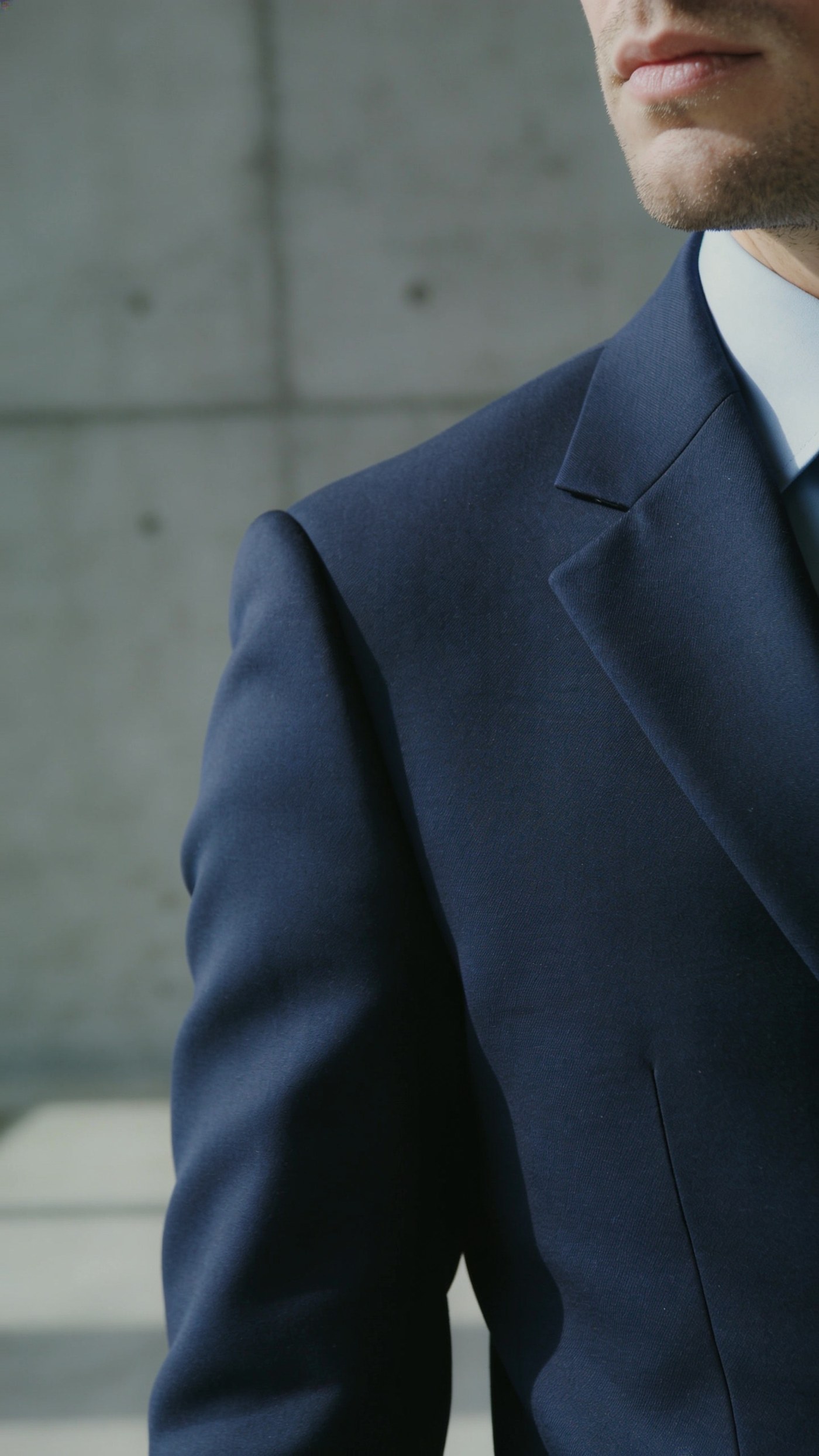
The shoulder is where a suit either fits a man or hangs on him. A structured shoulder uses padding and canvas to build a straight line out past the bone — it gives a narrow man a wider top half and a heavy man a cleaner one. It is also fixed. It holds its shape while you move inside it, so every time you reach, turn or lift an arm, the jacket stays where it was and your body travels under it.
A soft shoulder does the opposite. The padding is thin or absent, the sleevehead is set in with less structure, and the top of the jacket follows the actual slope of your shoulder. It moves when you move. On screen this reads as ease, because ease is literally what it is: less material fighting the body.
What to ask for:
- Unpadded or lightly padded. A quarter inch is plenty on most men.
- The shoulder seam should end where your shoulder ends. Overhang is the single most visible sign of a jacket that does not fit.
- Let the sleevehead sit soft. A roped, raised sleevehead is the loudest thing a jacket can do.
- Try it standing and then reaching forward. A soft shoulder should let you cross your arms without the whole jacket lifting.
An open collar lets you breathe
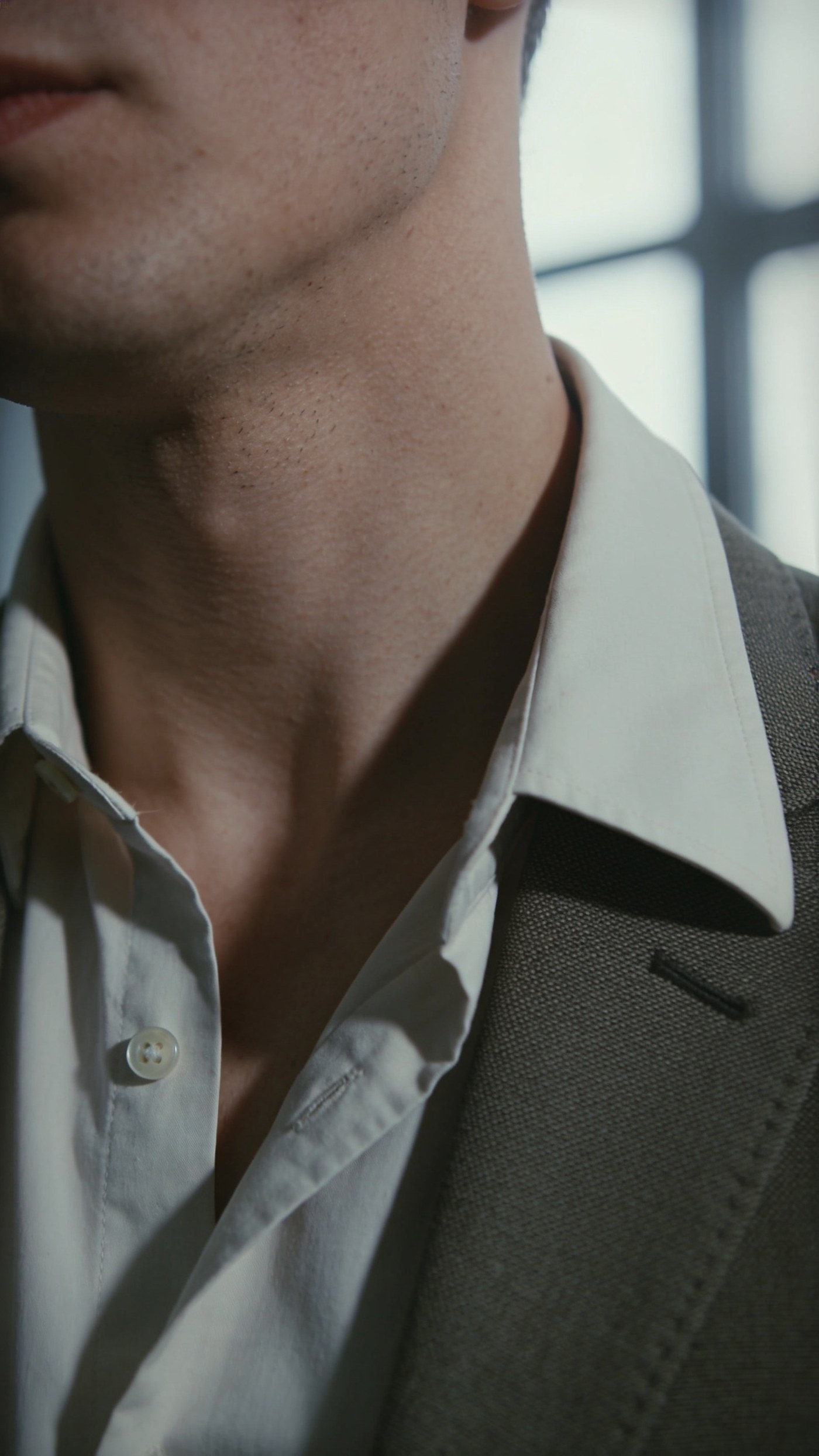
The Protagonist spends much of the film in tailoring worn without a tie, collar open. This is the detail most men get wrong, because a shirt cut for a tie does not work without one. The collar was designed to be held closed and supported at the knot; take the tie away and the points collapse inward, the band gapes, and the whole neckline sags into the jacket.
An open collar has to be built for it. That means a slightly taller band that stands on its own, a firmer interlining, and points long enough to sit under the jacket lapel instead of floating over it. Worn correctly it frames the face and reads as deliberate. Worn with the wrong shirt it reads as a man who took his tie off in the car.
The rules:
- One button open, never two. Two is a different film.
- Choose a collar with structure — a semi-spread with a firm band, not a soft unlined one.
- The points must reach under the lapels. Short points on an open neck look unfinished.
- Keep the shirt plain. Without a tie, the shirt is the whole upper half of the outfit.
Cashmere says nothing at all
The third choice is cloth, and it is the one that costs money. Rough worsted wool has a visible weave, a dry hand and a certain amount of glare under light. It announces itself across a room — which is fine for a suit meant to be seen, and wrong for a suit meant to disappear.
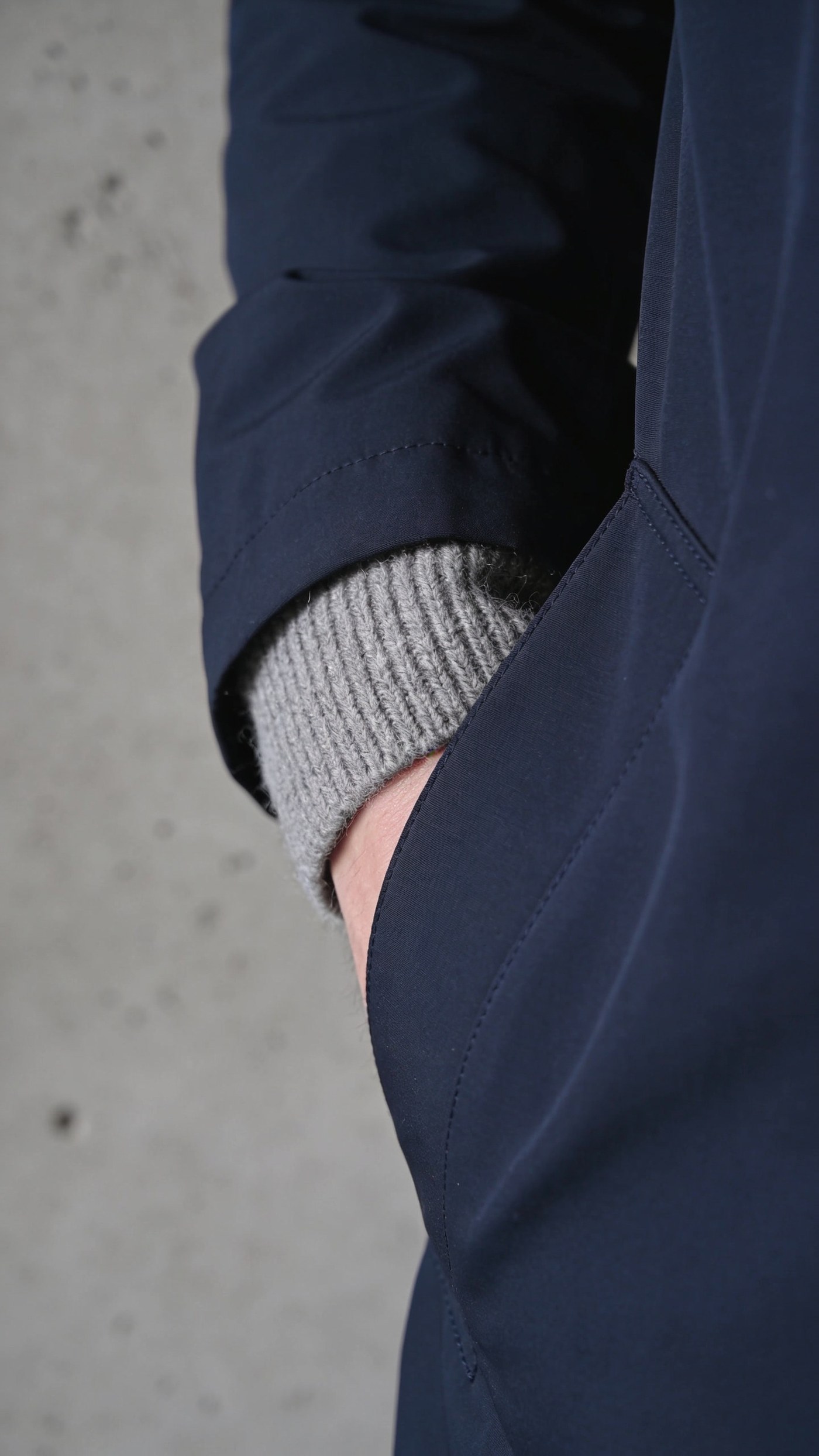
Cashmere and cashmere blends have almost no surface. The nap absorbs light instead of reflecting it, the drape is heavier and quieter, and the cloth falls rather than holds. The result is a jacket with no highlights, no sheen and no pattern for the eye to catch on. You notice the man; you do not notice what he is wearing.
This is worth being honest about: it is the expensive way to solve the problem, and cashmere wears out faster than good worsted. If the budget is not there, a high-twist wool flannel gets most of the way — matte surface, soft drape, no glare. What you are buying in both cases is the absence of shine.
The best suit is the one nobody remembers
Put the three together and you get a man dressed to be capable in, not to be photographed in. Nothing overhangs, nothing is held in place by an accessory, nothing reflects. Every decision removes something rather than adding it.
That is a harder brief than it sounds, and it is the opposite of how most men buy clothes. A strong shoulder, a bold cloth and a good tie are all easy to see working in a mirror. A soft shoulder and a matte jacket only prove themselves at the end of a long day, in a room full of people, when nobody has commented on what you are wearing and everyone has taken you seriously.
If you take one thing from this: get the shoulder right first. It costs nothing extra to ask for, it cannot be fixed later by an alteration, and it is the difference between a suit you wear and a suit that wears you.
Frequently asked
Is a soft shoulder right for narrow shoulders?
Usually yes, but not always. A soft shoulder shows your actual frame, so a narrow man gets a narrow line. If you want width, a light pad is a fair trade — just keep the sleevehead soft so it still moves.
Can I wear a suit with an open collar to the office?
In most offices, yes, provided the shirt is built for it. The failure is never the missing tie; it is a limp collar that was cut to sit under a knot.
Is cashmere worth it for a suit?
For a jacket, often. For trousers, rarely — cashmere wears through at the seat and knee far faster than worsted. A cashmere or cashmere-blend jacket with high-twist wool trousers is the durable version of the same look.
What colour works best for this?
Mid to charcoal grey, then navy. Both are matte-friendly, both take an open collar, and neither reads as an outfit. Brown works if the cloth is quiet enough.
How do I check the shoulder actually fits in the shop?
Stand square in front of a mirror and look at where the seam lands. It should sit on the bony end of your shoulder, not past it. Then cross your arms — if the collar lifts off your neck, the jacket is too structured for you.