When Harry Met Sally Style: Cable Knit, Corduroy and the Trench
The short answer: a cable knit has a carved surface that throws shadow, so one layer reads as deep instead of flat; corduroy catches light along every wale, which moves a plain jacket from no season into autumn; and a trench runs the body's vertical line down past the knee where a short jacket would cut it at the waist. Three textures, and together they are why the film still looks warm nearly forty years on.
Rob Reiner's 1989 film, written by Nora Ephron and costumed by Gloria Gresham, treats autumn in New York as a third lead, and Gresham dresses Harry and Sally for it with texture doing the work colour usually does. The famous piece is Harry's: Billy Crystal's cream cable knit in Central Park is one of the most copied menswear looks ever put on film. The corduroy and the trench live mostly on Sally's side of the screen, and they translate to a man's wardrobe without changing a thing. The three together are a complete lesson in layering for the cold half of the year.
A cable knit builds depth
A thin flat sweatshirt is one even surface. It takes light the way a wall does, loses its shape at the cuffs within a season, and under a jacket it adds bulk without adding anything to look at.
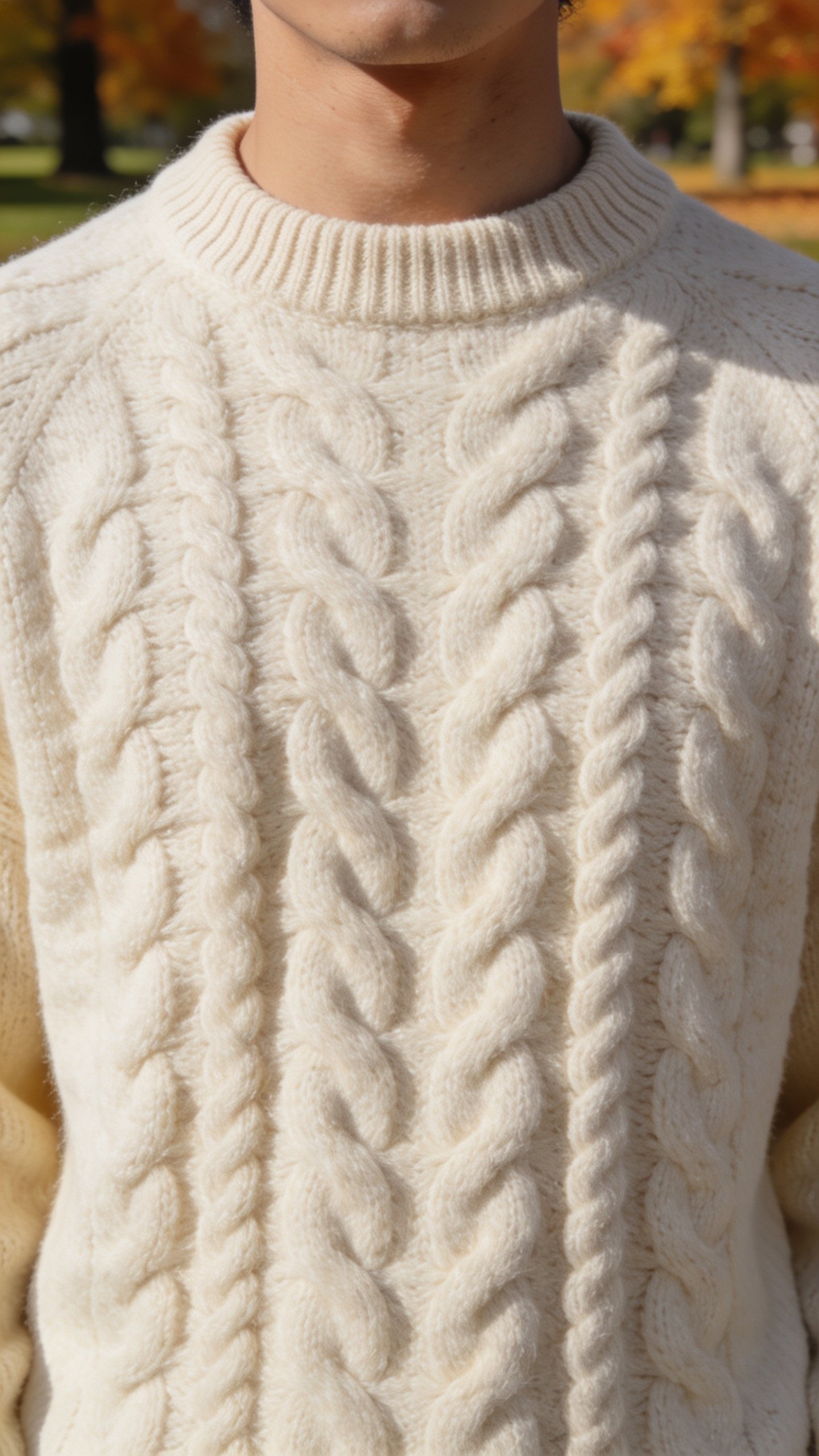
A cable knit is architecture. The crossed ropes of the cable stand off the chest, every ridge casts a small shadow, and the surface reads as carved rather than printed. That texture is why a single cream Aran style sweater with jeans is a finished outfit while a sweatshirt with jeans is a man on his way to somewhere else. The weight is real too: a proper cable is dense enough to be outerwear on a dry October day.
What to look for:
- Wool, and a chunky gauge. A fine merino cable loses the shadows that are the whole point.
- Cream or oatmeal first. Light colours show the cable best, which is why the film's version reads so strongly on camera.
- A mock neck or crew that sits close without choking.
- Cables that run full and deep across the chest, not a faint pressed pattern.
- Dense enough that you cannot see your shirt through it. Loose open knits sag by noon.
Corduroy reads like October
A smooth cotton jacket is seasonless in the wrong way. Under a grey sky a flat twill still says summer, the surface gives light nothing to do, and the garment reads thin even when it is not.
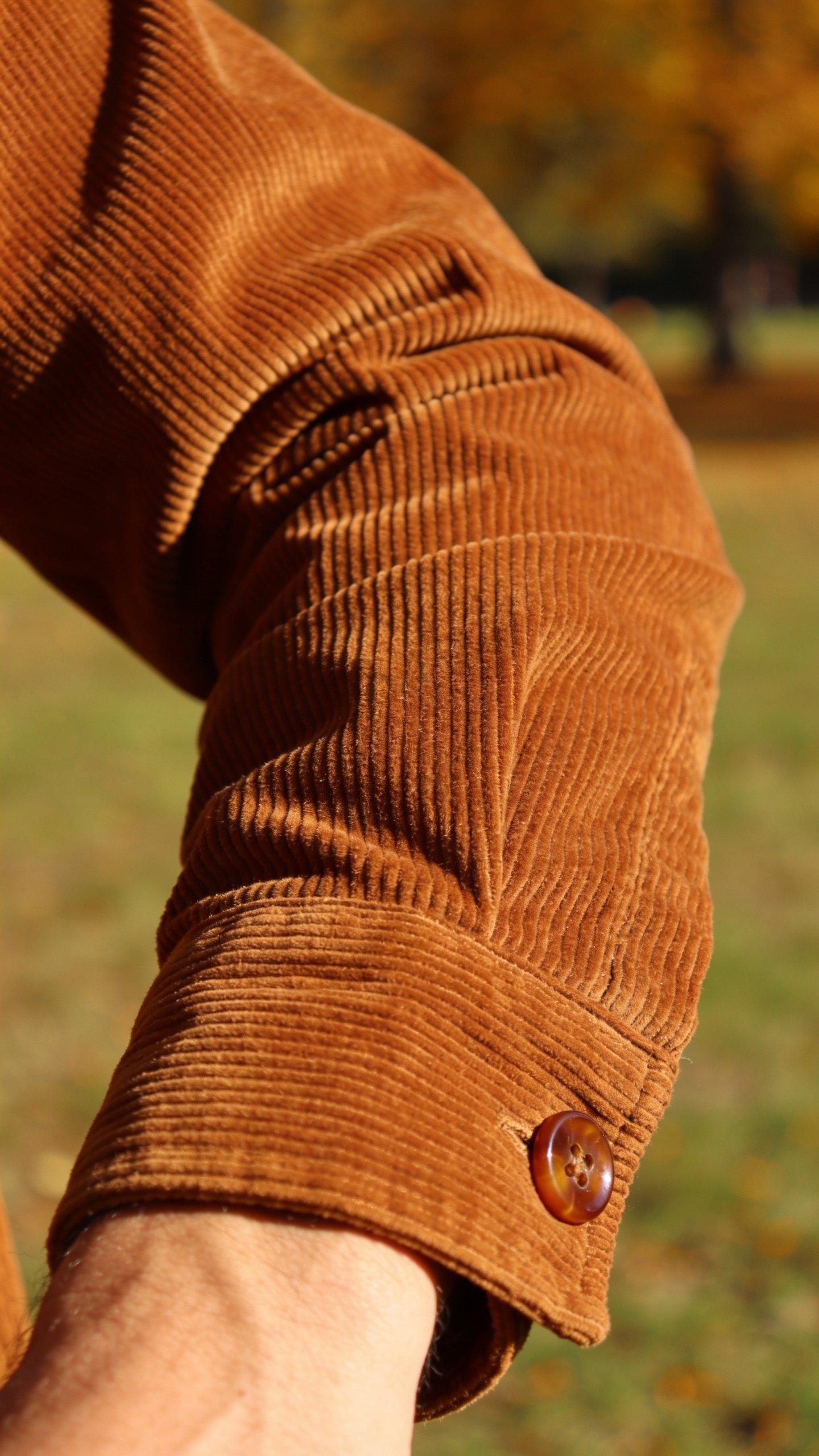
Corduroy is cut velvet in parallel ridges, and each wale is a thin line that catches light on one side and shades the other. The cloth looks warm from across a street, which no flat cotton manages, and it picks up a soft sheen at elbows and knees that reads as character rather than wear. In the film the corduroy sits on Sally's side of the wardrobe, a chocolate blazer over a knit, and the trick works identically for men: one corduroy layer turns the whole outfit to autumn.
What to look for:
- Mid to wide wale for jackets and trousers. Needlecord is shirt territory and reads formal.
- Earth colours. Tan, chocolate, olive and rust are what the cloth was born for.
- Cotton with a touch of stretch at most. Heavy synthetic blends kill the surface light.
- A corduroy blazer worn over a knit, not over a dress shirt, keeps it in the casual register where it belongs.
- Check the nap runs the same direction on every panel. Mismatched panels show as mismatched colour in daylight.
A trench carries the line down
A short jacket in autumn ends at the waist, and so does the outfit. The eye runs from the shoulder down, hits the hem, and stops in the middle of the body. Whatever the trousers are doing, they are doing it alone.
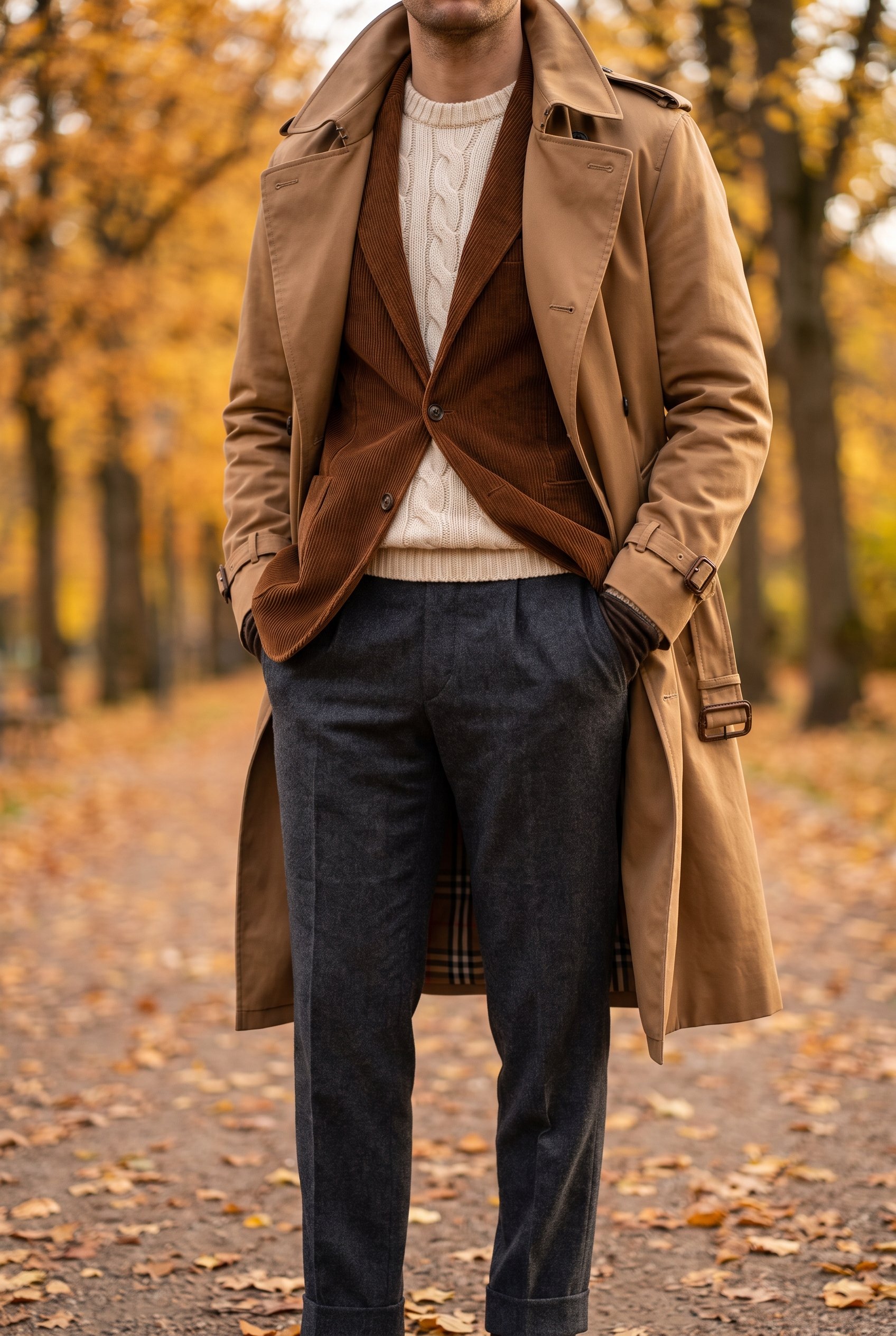
A trench takes the same body and gives it one line from shoulder to shin. The coat was engineered for weather a century ago, so everything on it works: the storm flap sheds rain off the shoulder, the belt closes the silhouette at the waist without cutting it, and the skirt moves when you walk, which is most of why a trench photographs well. In the film it is the classic New York autumn layer, and it remains the one coat that works equally over a cable knit and over a suit.
What to look for:
- Knee length or just past it. The length is the point; a short trench is a jacket with extra hardware.
- Cotton gabardine, the original cloth. It sheds rain, breathes and ages into its creases.
- Stone or khaki first, navy second. The pale coat over dark layers is the classic contrast.
- Raglan sleeves if you will wear knits underneath. They give the shoulder room without looking big.
- Belt it or knot it loosely in front. Hanging open and loose, a trench loses the waist and the line with it.
Soft, deep, sure
The order matters: cable knit against the body, corduroy or the knit alone in the middle of the day, trench over everything when the sky turns. Each layer has its own surface, so the outfit reads as three distinct textures instead of three thicknesses of the same thing, and that is the whole secret of looking considered in cold weather without a single loud piece.
Texture is what makes inexpensive clothes look deliberate. A plain sweatshirt, a flat jacket and a parka cost about the same as a cable knit, a corduroy layer and a second hand trench, and the two stacks could not read more differently across a room.
If you take one thing from this: buy the cream cable knit first. It is the piece from this film people still copy, it works with everything from jeans to grey flannel, and on a dry day it replaces a jacket entirely.
Frequently asked
Is a cream sweater practical?
More than it looks. Wool sheds dirt once it dries, and a chunky knit hides minor sins in its texture. Hand wash or use the wool cycle and it outlasts the trend cycle by a decade.
Can I wear corduroy trousers with a cable knit?
Yes, and it is a classic pairing, but split the colours: cream knit with tan or chocolate cords. Matching heavy textures in the same colour head to toe reads like upholstery.
Does a trench work over a chunky sweater?
If the coat allows for it. This is where raglan sleeves and a slightly generous cut earn their keep. A trim darted trench sized for a suit will pull across the back over a cable knit.
Belt tied or buckled?
Tied, loosely, in front. Buckled looks exact in a way the coat was never meant to be, and hanging loose it loses the waist. The knot is the accepted middle.
What shoes finish this?
White leather sneakers keep it where the film has it, suede chukkas or loafers dress it up a step. Anything with a heavy lug sole drags the whole outfit towards hiking.