Wall Street Style: Contrast Collar, Pinstripe and a Pocket Square
The short answer: a collar in a different colour from the shirt stops being background and becomes a frame around the knot; vertical stripes that run unbroken from shoulder to shoe add height the way a soft plain cloth never can; and a pocket square turns a suit from something worn into something signed. Three moves, all of them additions, all of them meant to be seen.
Oliver Stone's 1987 film puts Michael Douglas on a trading floor as Gordon Gekko, a corporate raider who dresses the way he negotiates, and the wardrobe became more famous than most of the dialogue. Costume designer Ellen Mirojnick built the look and brought in the tailor and menswear writer Alan Flusser to cut Gekko's suits, sharp shouldered, peak lapelled, unmistakably expensive, and the contrast collar shirt she put under them became the uniform of an entire decade of money. Where our last episode's thief dressed to vanish, Gekko dresses to win the room before he says a word. Same craft, opposite direction.
A contrast collar frames the knot
A soft collar in the shirt's own colour does its job quietly and disappears into the crowd of every other shirt in the room. Nothing wrong with that; it is simply not what this wardrobe is for.
A crisp white collar on a striped or coloured shirt body is a different instrument. The white cuts a clean line against both the shirt and the jacket, it frames the tie knot the way a mount frames a picture, and it pulls every eye in a meeting to the face above it. It carries a whiff of the nineteenth century, when collars were detachable and always white, which is exactly the old money signal the character is renting. It is the single loudest quiet object in menswear.
What to look for:
- A white collar on a blue, pink or striped body. The stronger the body, the harder the white line works.
- White cuffs to match the collar. Collar alone can read as an accident; collar and cuffs read as a decision.
- A spread or cutaway shape. This collar exists to display the knot, so give the knot room.
- Firm construction. A contrast collar that wilts by noon is worse than no contrast at all.
- One per outfit's worth of confidence: with this shirt, calm the tie or calm the suit. All three loud is carnival.

A pinstripe draws a man taller
Flat plain cloth hangs quietly and keeps a man exactly the height and width he arrived with. On a trading floor full of dark plain suits, it also keeps him invisible.
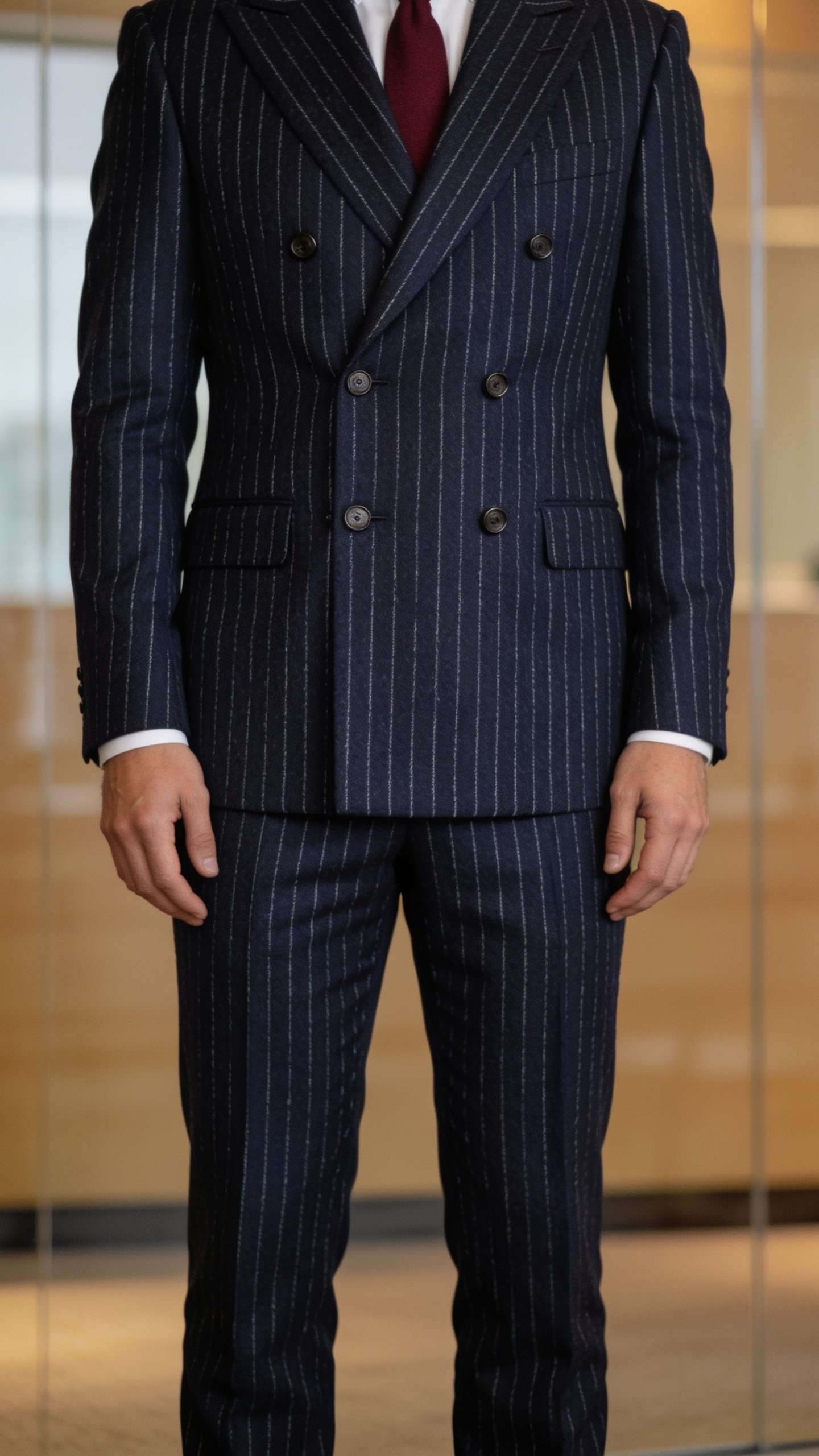
A pinstripe is a drawn line, and the eye follows drawn lines. Unbroken verticals from shoulder to trouser hem read as height and continuity, they give the dark suit an internal rhythm that plain cloth lacks, and at close range the stripe quietly announces tailoring, since stripes that match across seams and pockets cannot be made carelessly. Gekko's stripes are emphatic, banker's stripes with intent, and the film wears them with peak lapels and braces so every line in the outfit points up.
What to look for:
- A stripe you can see across a desk but not across a street. Chalk stripes are softer, pin stripes sharper.
- Navy or charcoal ground. The stripe is the statement; the ground colour should not compete with it.
- Stripes matched at the shoulder seams and pockets. This is the fastest quality check in the shop.
- Trousers cut long enough to keep the line unbroken. A stripe that stops at flood length defeats itself.
- Braces rather than a belt if you want the full period effect: nothing cuts the vertical line at the waist.
A pocket square signs the suit
An empty breast pocket says nothing, and on most suits that is fine. On a suit built to dominate a room, an empty pocket is a sentence left unfinished.
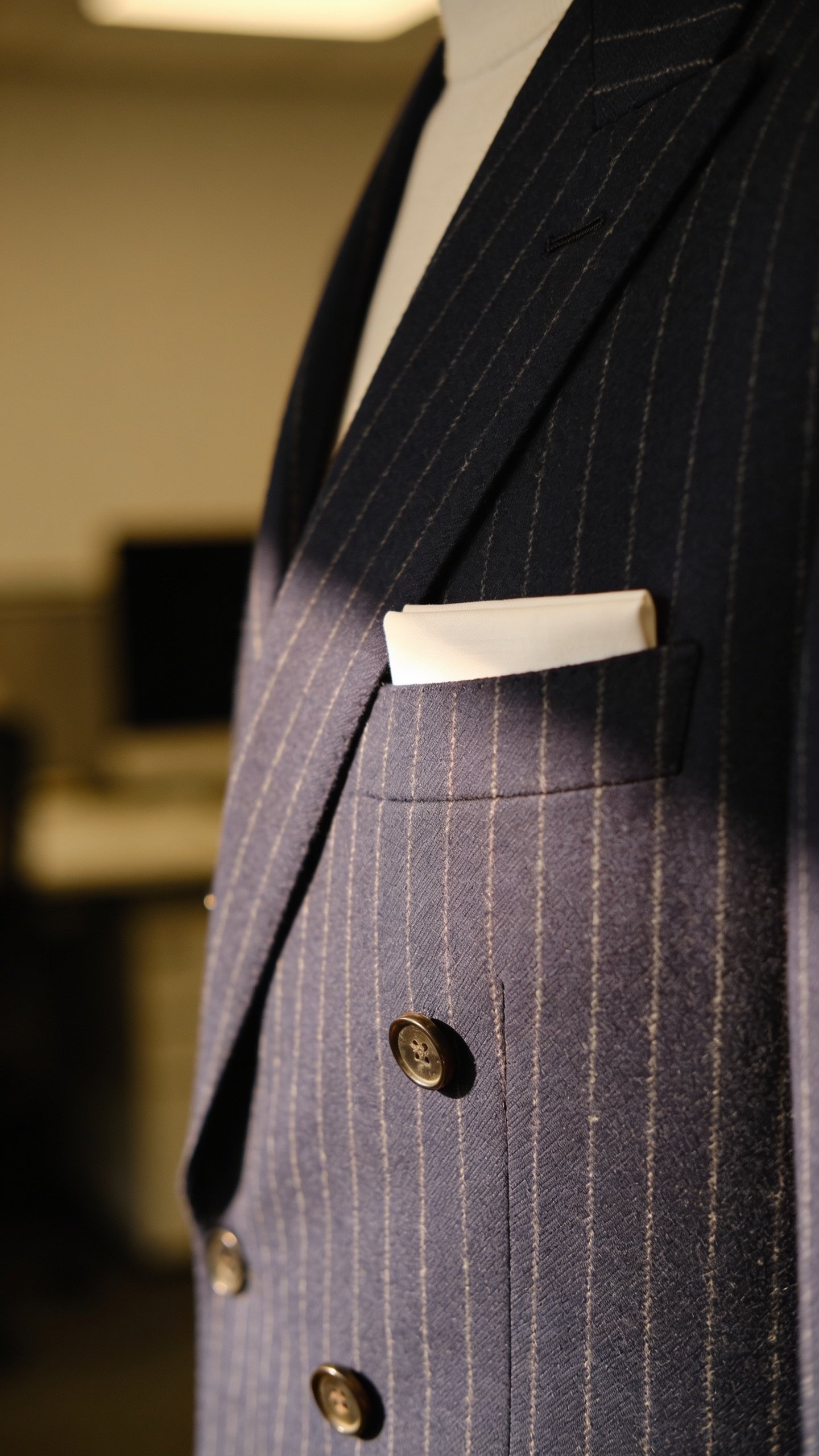
A pocket square is the smallest object in tailoring with the highest visibility per gram. One fold of white linen or a bloom of printed silk sits at the exact height where people actually look at each other, it separates the man who was dressed from the man who dressed, and it costs less than lunch. Gekko wears his the way he signs deals, deliberately and without apology. The mechanism is pure punctuation: the suit is the sentence, the square is the signature at the bottom of it.
What to look for:
- Start with white linen in a flat TV fold, a centimetre of straight white above the pocket. It goes with every suit made.
- Silk with a pattern for the deliberate version. Pick up a minor colour from the tie or shirt, never an exact match.
- A puff or casual fold softens the formality; the straight fold sharpens it. Match the fold to the meeting.
- Never the pre folded square sewn to a card. It photographs exactly like what it is.
- The square is the last thing on and the first thing seen, so put it in after the jacket and check it in a mirror.
Sharp, loud, deliberate
Put the three together and you have the opposite wardrobe to our Heat episode, built from the same understanding of how clothes read. The contrast collar pulls the eye to the face, the pinstripe takes the eye on a vertical tour and reports height and money, the pocket square signs the work, and the man inside has announced his intentions before his hand is out for shaking.
The film means it as a warning as much as a lesson, and the lesson still holds either way: visibility is a tool. Most days call for the quiet end of the dial, but when the day's actual job is to be seen, to pitch, to close, to stand at a lectern, these three moves are how tailoring raises its voice without saying a word.
If you take one thing from this: buy the pocket square first. It is the cheapest object on this page, it works on every jacket you already own, and it moves you from dressed to deliberate in the time it takes to fold it.
Frequently asked
Is a contrast collar office safe in 2026?
In most offices, yes, precisely because it reads as classic rather than fashionable now. Keep the body colour conservative, blue or a fine stripe, and let the collar be the only flourish. In a creative or casual office it will read as a costume; know your room.
Do pinstripes work on shorter or heavier men?
They are the friendliest pattern there is for both, which is why bankers of every build wore them. The caveat is scale: a wide, loud stripe on a small frame wears the man. Keep the stripe fine and the fit clean and the verticals do their quiet work.
White linen or printed silk for a first pocket square?
White linen, without hesitation. It is correct with everything from a navy blazer to a dinner jacket, it cannot clash with anything, and the flat fold takes ten seconds. Silk squares are the second purchase, not the first.
Can I wear all three at once like the film?
You can, and you will be making exactly the statement the film's character makes, which is worth being aware of. For civilian use, two out of three keeps the authority and drops the menace: pinstripe and square, or contrast collar and square.
What tie finishes this look?
Heavier silk in a confident solid or a bold repeating pattern, tied with a fuller knot than you would use on a point collar, since the spread of a contrast collar leaves room to fill. Keep it darker than the shirt body and the whole arrangement stays anchored.