A Single Man Style: Horn Frames, a Collar Pin and a Slim Black Tie
The short answer: a face needs a frame the way a picture does, and thin wire does not count as one; a shirt collar left to itself drifts apart and lets the tie knot sink into the gap; and a wide tie covers the shirt front while a slim one draws a single line down it. Three small objects, none of them a suit, and together they are the entire difference between dressed and composed.
Tom Ford's 2009 debut puts Colin Firth in 1962 Los Angeles as George Falconer, an English professor dressing through the worst day of his life, and the wardrobe is the point of the film. Costume designer Arianne Phillips built the suits on the boxier early sixties shape, had the shirts made at Turnbull and Asser, and kept the palette in warm browns to match the film's light. She has described the way George dresses as armour for what is happening inside him. That is why the lesson of this film is not the suit. It is the discipline of the small fixed points around the face, and every one of them is a thing you can buy this afternoon.
A horn frame holds the face
Thin metal glasses are designed to disappear, and on camera they succeed. The face above a suit reads as unfinished, the eyes have no architecture around them, and the overall impression is of a man who considers his glasses a medical device.
A heavy frame in the horn tradition does the opposite. The thick dark rim is a strong horizontal line across the strongest point of the face, it squares soft features the way a lapel squares a shoulder, and it reads as a decision rather than a prescription. George's thick black frames are so central to the film's look that they became the single most copied object in it. The mechanism is the same one the suit uses: a defined edge where there was none.
What to look for:
- A thick rim in black or dark tortoise. Acetate does the job honestly at normal prices; real horn is the luxury version of the same line.
- A squared or softly squared shape. Round frames in this weight read as deliberate eccentricity, which is a different outfit.
- The top line of the frame sitting level with your eyebrows, not above or below them.
- Width matching the face: the frame should end where your temple does, not overhang it.
- Matte or near matte finish. High gloss plastic reads cheap in daylight.

A collar pin lifts the knot
Left alone, a soft shirt collar opens as the day goes on. The two points drift apart, the tie knot settles into the gap, and by afternoon the tidiest morning knot is sitting a centimetre lower than it was tied, with daylight showing on both sides of it.
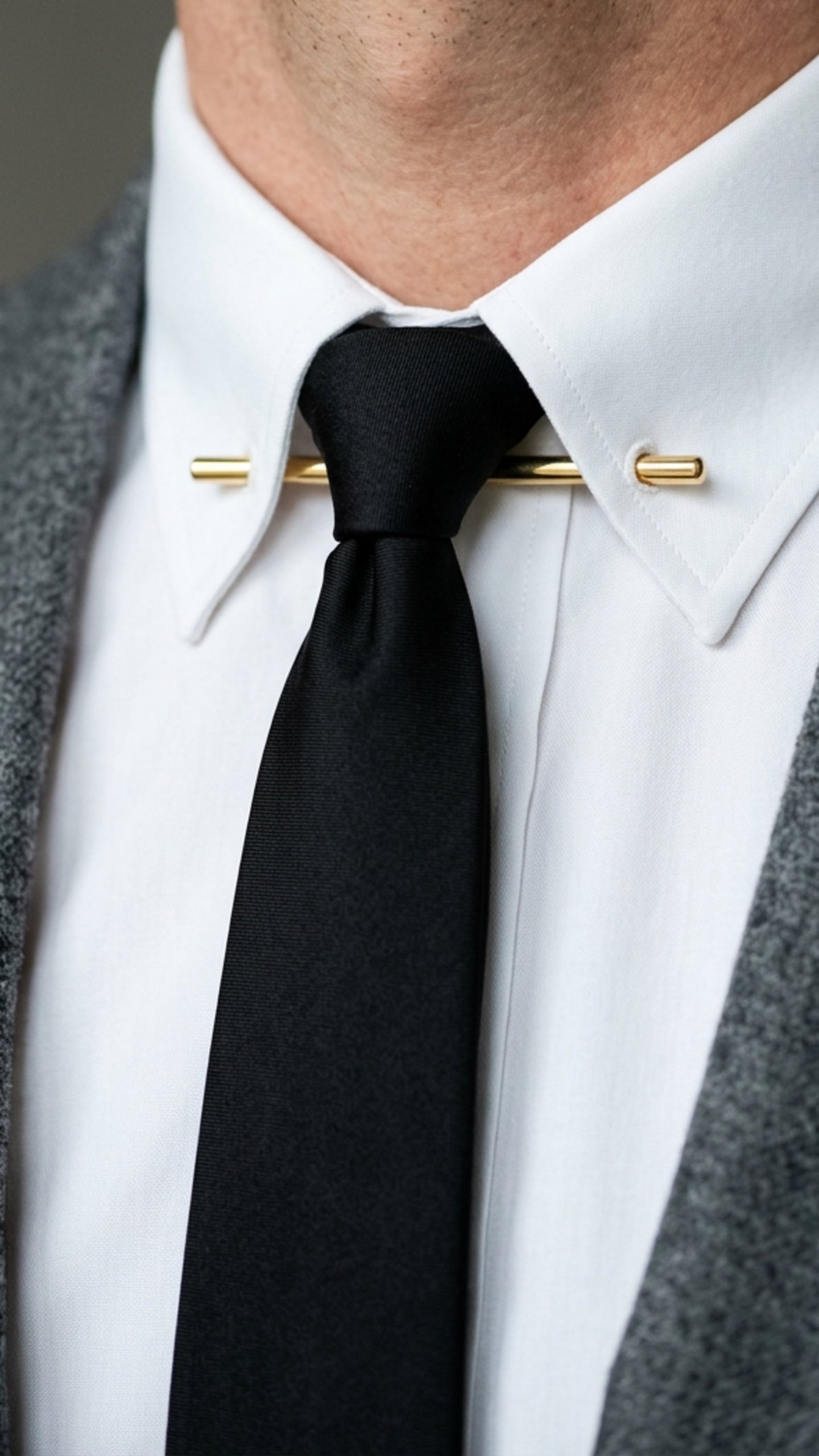
A collar pin is the period's answer, and it has never been improved. The pin passes under the knot and joins the two collar points, which does two things at once: it closes the collar so no daylight shows, and it lifts the knot up and forward so the tie arcs slightly off the chest. The knot goes from resting on the shirt to presented by it. In the film the visible hardware is a tie bar at the chest, and the collar pin applies exactly the same discipline one step higher, at the throat, where it matters most. It is the cheapest object in this whole wardrobe and the one that changes a shirt and tie the most.
What to look for:
- A barbell pin with a screw end, or a clip bar if your collars are not pierced. The safety pin style needs eyelet collars made for it.
- A collar with short to medium points. Long point collars swallow the pin and the lift.
- The pin sits under the knot, not across it. If the metal crosses in front of the tie you are wearing it as a brooch.
- Silver or gold to match whatever other metal you wear. One metal per outfit.
- Tie the knot slightly smaller than usual. The pin pushes it forward, and a big knot pushed forward crowds the collar.
A slim black tie just answers
A wide tie is a statement across the shirt front. At twelve centimetres it covers most of the visible shirt, it demands a big knot, and whatever else the outfit is doing, the tie is doing it louder.
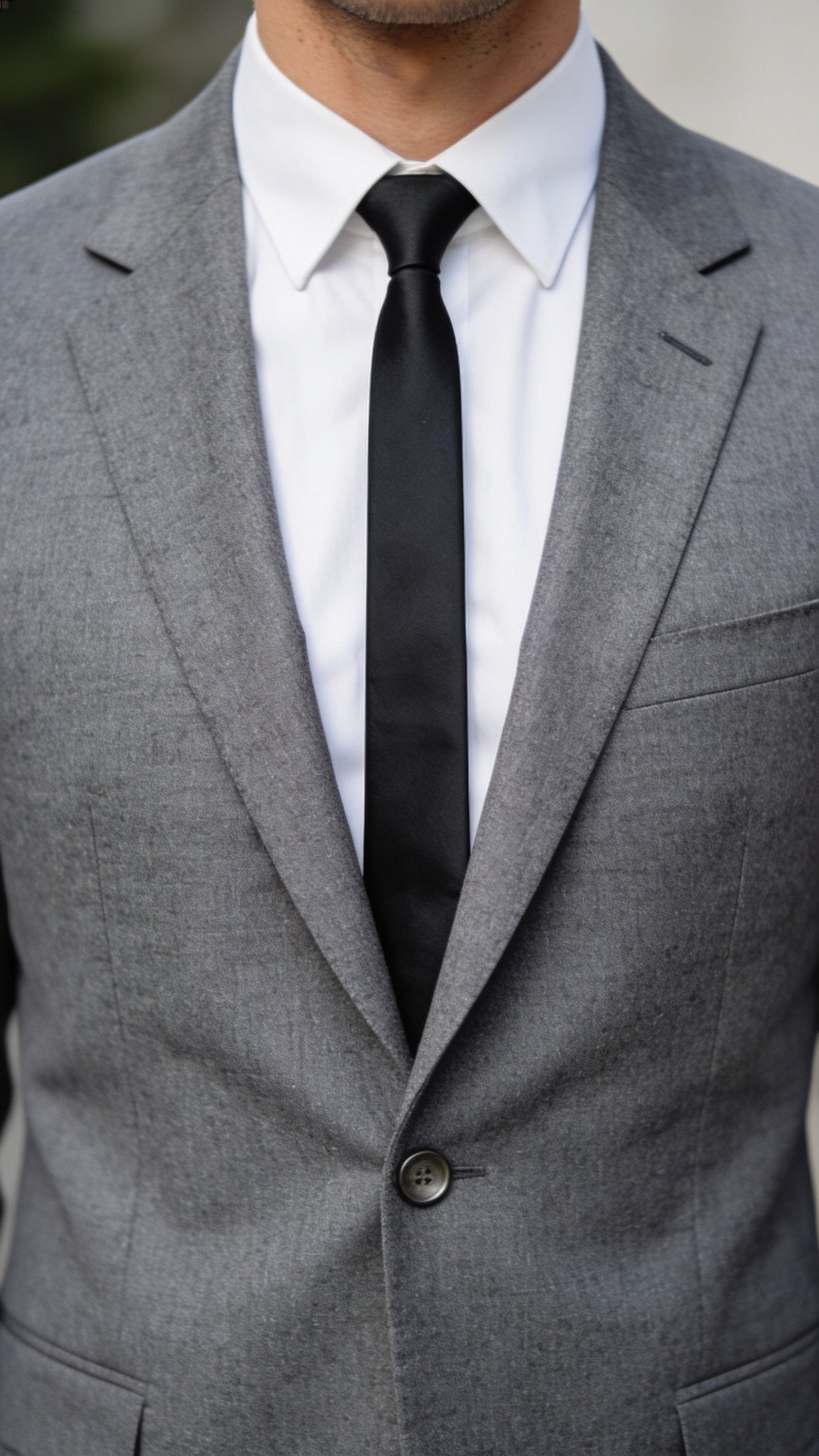
A slim tie, six centimetres or so, is a reply instead of a speech. It draws one dark vertical line down the middle of the shirt, takes a small neat knot that fits inside a pinned collar, and leaves the shirt, the lapels and the face to do their work. George keeps his ties narrow and dark, in the same quiet register as the suit, and the effect is a man whose clothes agree with each other. Black silk is the purest version of the idea: no colour decision at all, just the line.
What to look for:
- Six centimetres wide, give or take a few millimetres. Below five reads as a costume from a different film.
- Black or the darkest version of the suit's own colour. The tie should sit deeper than everything around it.
- A four in hand knot, small and slightly asymmetric. Big triangular knots belong to wide ties and wide collars.
- Silk with a dry handle, or a knitted tie for the casual version of the same width.
- Length to the trouser waistband. A slim tie that ends short turns the whole look into a comedy sketch.
Exact, quiet, composed
Put the three together over one dark suit and one white shirt and you have what the film actually shows: a uniform. Nothing in it is loud, nothing is optional, and nothing is approximate. The frames give the face an edge, the pin keeps the knot where it was tied, the slim tie keeps the shirt front quiet, and the man inside can be having the worst day of his life without his clothes reporting it.
That is also the practical appeal. This is the cheapest complete lesson in this series: a pair of heavy frames, a collar pin and a slim black tie cost less together than one decent jacket, and all three work on top of the suits you already own.
If you take one thing from this: buy the collar pin first. It costs the least, nobody else at your office owns one, and it upgrades every shirt and tie you already have by a visible step.
Frequently asked
Do heavy frames work on every face?
Most, with the width matched honestly. A narrow face takes a slightly thinner rim, a wide face a bolder one. The only real mistake is a frame wider than the face it sits on.
Can I wear a collar pin without glasses or a full suit?
Yes. A pinned collar with a knitted tie and an odd jacket is a complete look. The pin reads as care, not costume, as long as the rest of the outfit stays quiet.
Does a collar pin damage the shirt?
A clip bar does not touch the cloth at all. A barbell pin pushed through a soft collar leaves holes that mostly close with washing, but on fine shirts use eyelet collars made for the job.
Is a black tie too severe for daytime?
With a white shirt and a dark suit it is formal but not funereal, which is exactly the register the film uses. If it feels hard, deep navy or dark brown gives the same line with a degree less contrast.
What watch finishes this look?
Something small, thin and on a leather strap. The whole wardrobe is about quiet precision, and a large sports watch argues with every other decision in it.