
1. Introduction: More Than a Designer, a Visual Storyteller
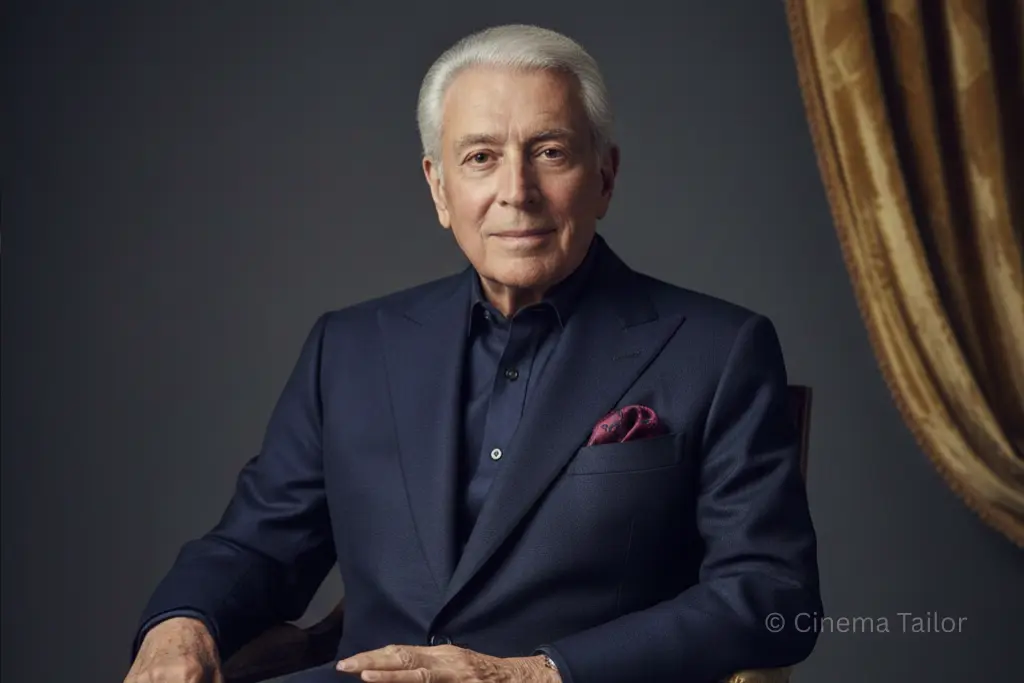
I still remember the first time I paused a film—not for the dialogue, not for the plot, but for the way a man stood in his suit. It was one of those moments when you realize that something invisible is doing the heavy lifting. The posture. The silence. The authority. That moment was when I understood that cinema teaches men how to inhabit power visually.
When we think of Valentino Garavani, the immediate association is often high fashion, the red carpet, and an untouchable level of luxury. But through years of studying film, tailoring, and the psychology of masculine presence, I’ve come to see Valentino differently. He was not merely a designer. He was a visual strategist—a master of cinematic tailoring who understood that on screen, a suit is never just a suit.
In Valentino’s world, a suit is armor. It is a social signal, a psychological framework, and a narrative device that communicates a character’s inner hierarchy before he ever speaks. Throughout his career, Valentino didn’t simply dress actors—he engineered protagonists. From the ceremonial gravity of The Last Emperor to the modern blueprint of masculine elegance that still defines leading men today, his work shaped how authority looks on screen.
At Cinema Tailor, we study Valentino not as a fashion icon, but as an architect of visual power. In this exploration, we examine how his tailoring language moved from the atelier to the cinema, and why his philosophy remains essential for any man who wants to understand presence, discipline, and authority in the modern world.
2. The Historical Authority of ‘The Last Emperor’
2.1 Clothing as a Narrative Device
In the 1987 masterpiece The Last Emperor, the challenge was to depict a man caught between two worlds: the ancient traditions of the Forbidden City and the encroaching modernity of the West. Valentino’s involvement in the film’s aesthetic brought a level of bespoke craftsmanshipthat authenticated this transition.
As the protagonist moves into Western-style clothing, the suits designed under Valentino’s influence act as a bridge. The sharp shoulders and structured lapels signify a man trying to find his footing in a rapidly changing world. This is the essence of movie costume design—using fabric to tell a story that dialogue cannot reach.
2.2 The Precision of the Italian Silhouette
The suits seen in this era of cinema were characterized by a distinct Italian suit silhouette. Unlike the boxy American cuts or the stiff British military style, Valentino’s influence brought a softer yet commanding presence. The high armholes and tapered waist created an athletic, authoritative V-shape that has become the gold standard for cinematic power dressing.
3. Valentino Red: The Visual Language of Power and Passion
3.1 Beyond the Gown: Red in Masculine Aesthetics
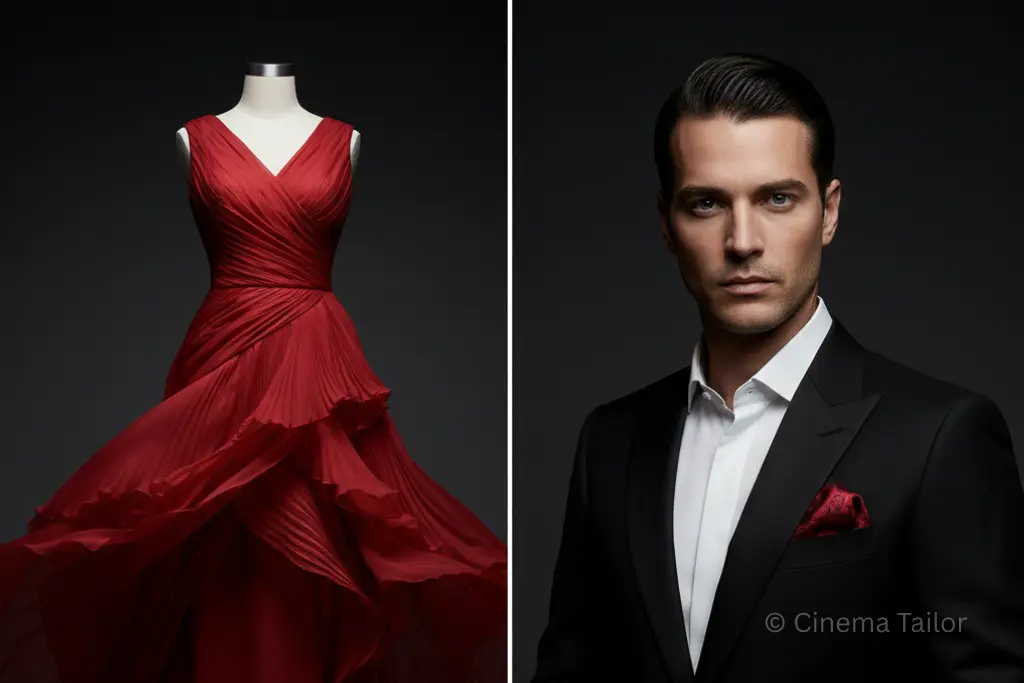
The term “Valentino Red” is legendary in the fashion world, usually associated with breathtaking evening gowns. However, in the context of cinematic tailoring, the use of red is a strategic masterstroke. Valentino understood that red is the color of the heart, the blood, and the fire.
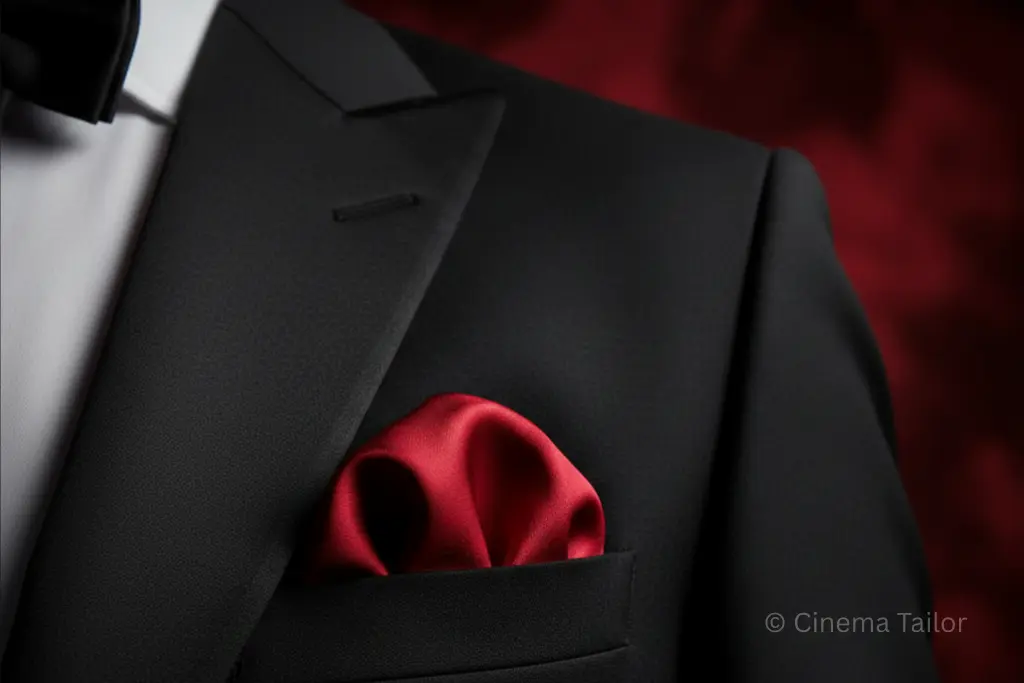
In film, when a man wears a black tuxedo but accents it with a Valentino-red silk pocket square or a subtle lining, it creates a visual “pop” that draws the audience’s eye. It suggests a hidden passion or a dangerous edge beneath a composed exterior. This contrast between the somber black of a tuxedo and the vibrant Valentino red is a recurring theme in high-end movie gala scenes.
3.2 Impact on Mise-en-scène
Directors love Valentino’s palette because it simplifies their job. A single red element in a frame can balance a complex scene. For a Cinema Tailor, observing how Valentino balanced these colors provides a blueprint for how we can add personality to even the most conservative bespoke suits.
4. The Evolution of the Modern Hero: From Valentino to Bond
4.1 Setting the Blueprint for the 007 Look
While brands like Tom Ford or Brioni are currently associated with James Bond, the DNA of that “Spy Chic” look owes everything to the era of Valentino Garavani. The 1960s and 70s saw Valentino perfect the slim, mobile, yet razor-sharp suit.
A hero must be able to fight, run, and seduce—all without a wrinkle in his lapel. Valentino’s mastery of fabric weight and drape made this possible. He moved away from heavy, restrictive wools toward lighter, high-twist fabrics that retained their shape, a hallmark of the Italian suit silhouettethat modern cinema still relies on.
4.2 The Psychology of the Perfectly Tailored Suit
Why does a Valentino suit make a character look smarter? It’s in the mathematics of the cut. By emphasizing the shoulder-to-hip ratio, the tailoring creates a subconscious perception of reliability and strength. In cinema, this “perfect fit” is a shortcut to establishing a character’s competence.
James’s Perspective
The most powerful suits in cinema are never loud. They don’t chase attention—they command it. Valentino understood that restraint is what gives a man gravity. When a suit fits perfectly, it removes distraction. All that remains is intent, posture, and silence. That is where true authority begins.
5. Hand-Stitched Excellence: The Details That Matter
5.1 The Art of the Pick Stitch
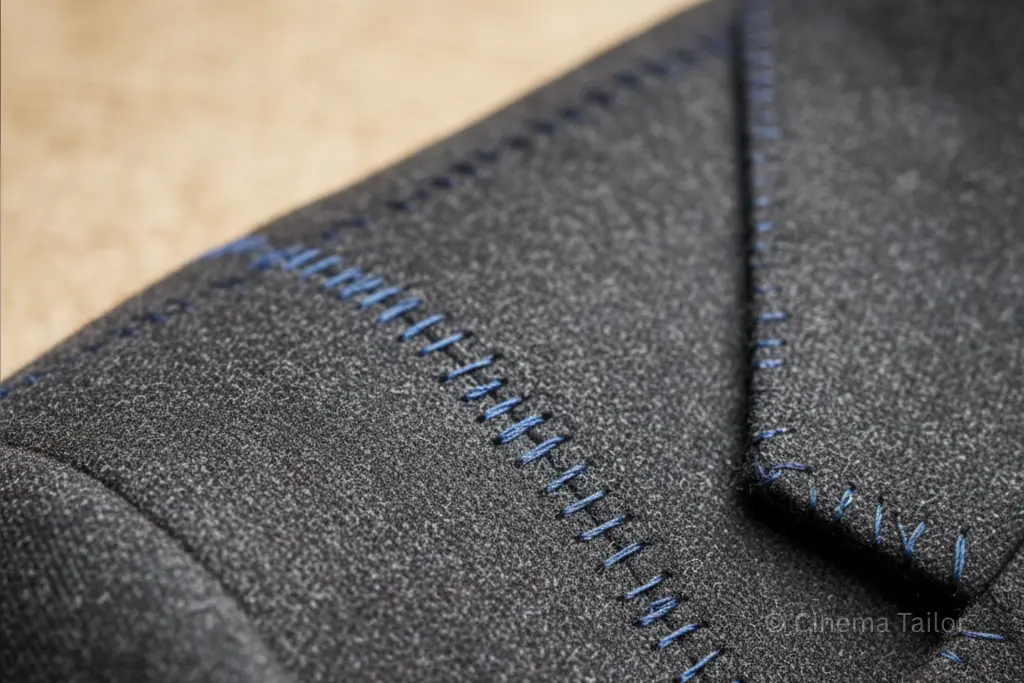
True luxury is quiet. One of the most significant contributions of bespoke craftsmanshipto cinema is the “pick stitch”—those tiny, visible hand-stitches along the edge of the lapel. In close-up shots, these details signal to the audience that the character is a person of means and taste.
Valentino was a staunch advocate for these artisanal touches. He believed that the soul of a garment lived in the parts that a machine could not replicate. At Cinema Tailor, we often highlight these “Sartorial” details because they represent the bridge between clothing and art.
5.2 Lapel Width and Character Arc
Notice how lapel widths change in films. A wider lapel often suggests a more traditional, grounded character, while a narrower, sharper lapel suggests modernity and speed. Valentino played with these proportions with surgical precision, ensuring the suit always matched the era and the ego of the character.
6. Sustainability of Style: Valentino’s Lasting Legacy
In an age of fast fashion, the work of Valentino Garavanistands as a testament to the “Lasting Emperor” of style. His suits from forty years ago look as relevant today as they did then. This “timelessness” is exactly what we strive for when discussing modern gentleman style.
The cinematic world continues to borrow from his archive. Whether it’s a period piece or a futuristic thriller, the principles of balance, color contrast (Valentino Red), and the Italian suit silhouetteremain the foundation of professional costume design.
7. Conclusion: Becoming Your Own Protagonist
Over the years, I’ve learned that the men who leave the strongest impression are rarely the loudest. They are the ones who seem composed even before they speak—men whose clothing doesn’t decorate them, but supports them. Valentino Garavani understood this instinctively. His contribution to cinema was not about trend or excess; it was about giving structure to masculinity in moments of pressure.
Valentino showed us that when a man steps into a perfectly tailored suit, he is not simply changing outfits—he is stepping into a role. The cut of the shoulder, the discipline of the silhouette, the restraint of color—all of it works together to create a visual language of competence and authority. On screen, this turns actors into protagonists. In real life, it can do the same for us.
At Cinema Tailor, we believe your wardrobe is not an accessory to your life—it is part of its architecture. By understanding the principles that masters like Valentino embedded into cinema, you begin to dress not for trends, but for longevity, presence, and purpose.
This analysis belongs to Cinema Tailor’s study of tailoring as visual storytelling. The broader stylistic framework is explored in The Ultimate Guide to Italian Suit Style.
For a philosophical understanding of how tailoring constructs authority on screen, see A Man’s Suit Is His Armor: The Architecture of Authority.
James is a UI software expert with over 20 years of experience in the IT industry.
He is the editor of Cinema Tailor, where he analyzes cinematic style and visual storytelling through a structured, system-level perspective.