
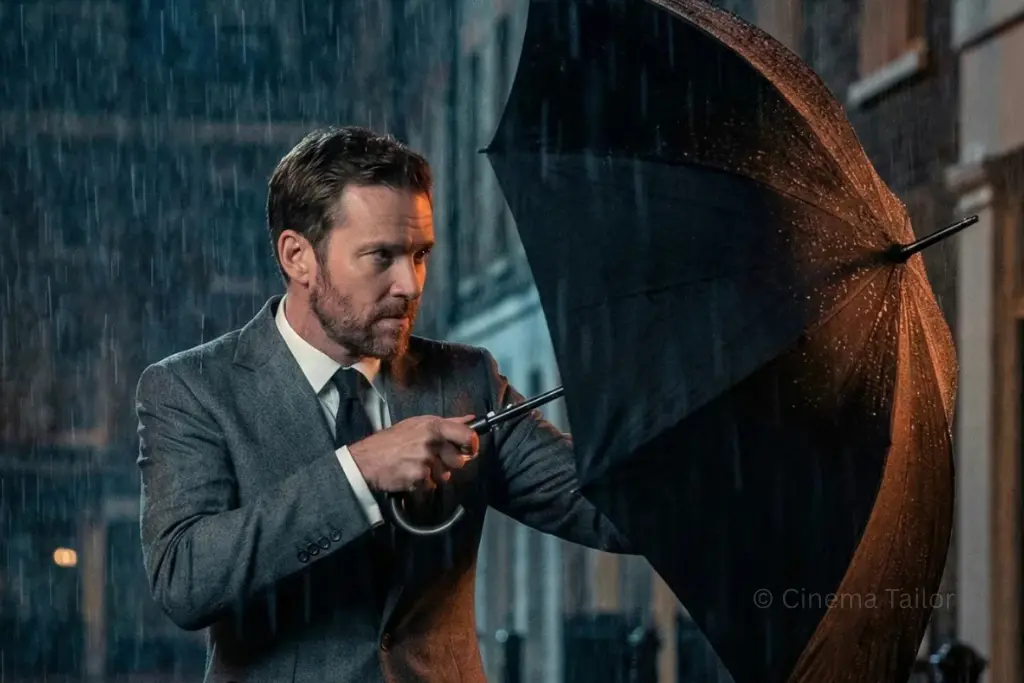
Introduction: Why I Once Believed in Kingsman’s Bulletproof Suit
I’ll admit it openly.
There was a time when I wanted Kingsman’s bulletproof suit to be real.
Not as a novelty, not as a collector’s item—but as something wearable. Something elegant. Something that would allow a man to walk through chaos untouched, composed, untouchable. Watching Kingsman: The Secret Service for the first time, I remember thinking that the suit itself was the ultimate evolution of masculinity: refined, lethal, and invincible.
But the more I studied tailoring, materials, and cinema, the more I realized something important.
Kingsman’s bulletproof suit is not a product. It is a philosophy.
At Cinema Tailor, we don’t ask whether something is possible. We ask why it was imagined in the first place. And the fantasy of Kingsman’s bulletproof suit tells us far more about men, authority, and fear than it does about ballistic fabric.
The Dream of Invincibility and the Modern Gentleman
Every era creates its own armor.
In medieval times, it was steel.
In the industrial age, it was uniform.
In the cinematic age, it became the suit.
Kingsman’s bulletproof suit represents the modern man’s desire to remain civilized under fire.
To stay elegant when the world becomes hostile.
This is why the image of Harry Hart calmly adjusting his cuff while bullets rain down is so powerful. The suit does not panic. The man does not flinch. The chaos remains external.
That is the real fantasy—not stopping bullets, but maintaining composure.
Reality Check – Why Kingsman’s Bulletproof Suit Cannot Exist (Elegantly)
Here is where cinema and physics part ways.
The Material Problem
True ballistic protection requires layers—Kevlar, Dyneema, ceramic composites. These materials are:
- Thick
- Heavy
- Rigid
- Resistant to drape
A tailored suit depends on flow, shape, and balance. Replace wool with ballistic fiber, and the silhouette collapses. The suit becomes armor in the medieval sense—functional, but visually brutal.
The Weight Problem
A fully bullet-resistant garment weighs enough to alter posture and gait.
Instead of authority, it produces tension. Instead of elegance, fatigue.
In other words: a real bulletproof suit destroys the very thing a suit is meant to protect—presence.
Cinema Case Study — Kingsman vs. John Wick
To understand why Kingsman’s bulletproof suit is a beautiful fantasy, compare it with John Wick.
John Wick wears suits designed for movement, not invincibility. They tear, stain, and fail—because the character himself is not meant to be untouchable. Wick survives through skill and brutality.
Kingsman, on the other hand, is aspirational. It is not about survival—it is about order.
The bulletproof suit exists to preserve decorum in impossible circumstances.
This distinction matters.
One film explores violence. The other explores authority.
What Kingsman’s Bulletproof Suit Is Really Protecting
If it cannot protect the body, what does it protect?
Psychological Armor
A well-tailored suit creates a psychological boundary. It reminds both the wearer and the observer that there are rules—even in chaos.
Social Authority
People hesitate around structure.
A suit, even without ballistic capability, discourages dismissal.
This is why a bespoke suit costing $5,000 often grants more real-world protection than a $50,000 armored garment. It shields reputation, credibility, and command.
James’s Perspective
When I stopped asking whether a suit could stop a bullet, and started asking what it stops socially, everything changed. A well-made suit doesn’t protect your body—it protects your position. And in the modern world, that is often far more valuable.
The Suit as Modern Armor (Without Ballistics)
The true genius of Kingsman’s bulletproof suit lies in its symbolism.
- Structure replaces steel
- Discipline replaces padding
- Elegance replaces aggression
A suit is not meant to survive ambushes.
It is meant to survive meetings, negotiations, pressure, scrutiny.
In that sense, every good suit already functions as modern armor.
Why the Fantasy Still Matters
Some might argue that because Kingsman’s bulletproof suit isn’t realistic, it isn’t useful. That is a mistake.
Myths exist to point us toward values.
Kingsman points toward restraint, preparation, and composure.
The fantasy endures because men still want to believe they can remain calm, precise, and dignified—even when the world turns hostile.
FAQ: The Hard Truth About Ballistic Tailoring
Q1. Can a suit fabric itself be bulletproof like in Kingsman?
A: In short, no. Physics cannot be bypassed by clever weaving alone. To stop a high-velocity projectile, you need multiple layers of high-tensile fiber to catch and displace energy. The only real-world “Kingsman” method is integrating ultra-thin UHMWPE panels into the suit’s internal lining.
Q2. Will I walk away unscathed if I’m hit while wearing a ballistic suit?
A: Absolutely not. Think of it as a vehicle crash; the seatbelt and airbag save your life, but the impact is real. You will feel the full kinetic force, likely resulting in severe bruising or fractured ribs. It is a tool for survival, not invincibility.
Q3. Why isn’t every bespoke suit reinforced with armor?
A: It’s a trade-off between risk and utility. Ballistic panels add weight, eliminate breathability, and compromise the natural flow of fine wool. Unless you are operating in a high-threat environment, the “Overhead” of the system often outweighs the daily benefits.
The Reality Check: Personal Safety Architecture
Before investing in ballistic tailoring, run through this hardware checklist to ensure your “physical firewall” is functional, not just theatrical.
- [ ] NIJ Certification: Does the ballistic insert carry a genuine NIJ (National Institute of Justice) Level II or IIIA rating?
- [ ] Sartorial Integrity: Does the suit maintain its “Drape”? A security system that is visible to the naked eye has already failed its first protocol.
- [ ] System Elasticity: Can you maintain full range of motion? Test the armholes and back tension to ensure the armor doesn’t create a “bottleneck” in your movement.
- [ ] Back-end Trauma Protection: Does the setup include trauma pads? Stopping the bullet is only half the battle; absorbing the kinetic energy is what prevents internal system failure (broken ribs).
- [ ] Thermal Management: Have you accounted for the zero-breathability of UHMWPE? Ensure your base layer is designed for high-performance moisture wicking.
- [ ] Lifecycle Management: Is the armor within its 5-year operational window? Ballistic fibers degrade over time—don’t rely on an expired “Legacy System.”
Conclusion: What I Learned by Letting the Fantasy Go
Letting go of the idea of Kingsman’s bulletproof suit didn’t disappoint me.
It clarified me.
I realized that I didn’t want invincibility.
I wanted control.
Today, when I put on a structured suit, I no longer imagine bullets bouncing off fabric. I think about posture, tone, and restraint. I think about how armor, in the modern sense, is something you project, not something you hide behind.
Kingsman’s bulletproof suit is a beautiful fantasy.
And like all good fantasies, its value lies not in literal truth—but in what it teaches us about who we want to be.
In the end, a gentleman doesn’t need to stop bullets.
He needs to stop chaos—from entering him.
That is the real armor.
This article expands on the foundational idea introduced in
A Man’s Suit Is His Armor: The Architecture of Authority
where authority is framed as psychological rather than ballistic.
To explore how modern armor extends beyond the suit itself, see
Kingsman Essentials: Glasses, Umbrellas, and the Art of the Strategic Accessory.

James is a UI software expert with over 20 years of experience in the IT industry.
He is the editor of Cinema Tailor, where he analyzes cinematic style and visual storytelling through a structured, system-level perspective.