
Introduction: Middle-aged men’s fashion
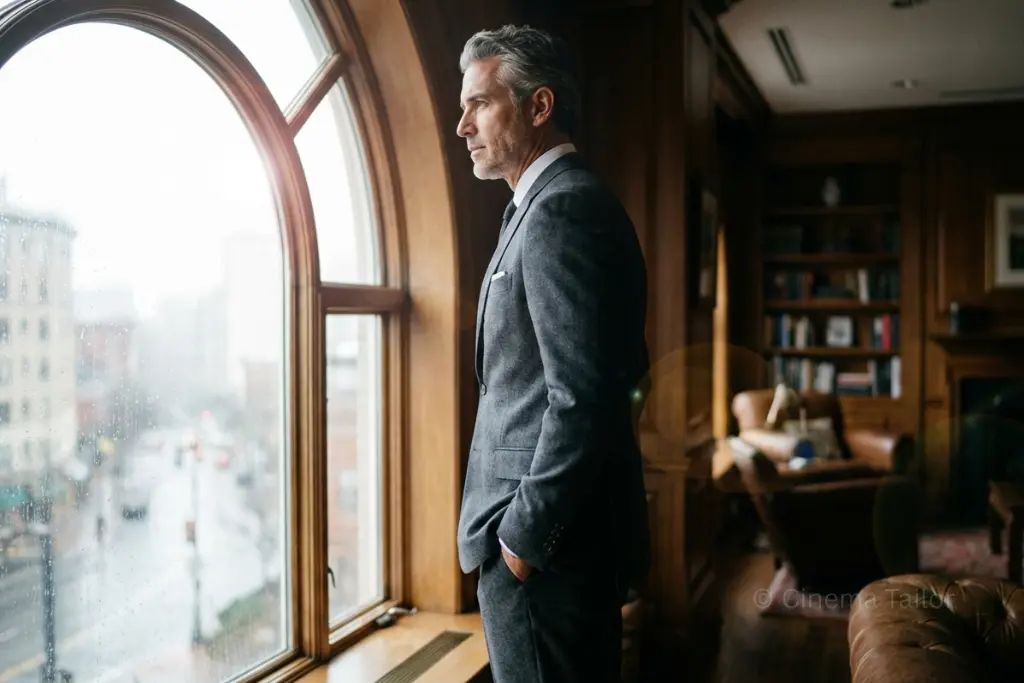
In a world obsessed with the fleeting spark of youth, there is a profound, often overlooked truth in the realm of masculinity: a man’s true aesthetic peak often begins where his youth ends. This isn’t about fighting the clock; it’s about mastering it. In the sartorial world, we call this ‘Aging Classic Style.’ Like a bespoke suit that molds to the wearer over decades or a fine vintage wine that develops complexity in the cellar, a man’s style and aura gain a unique depth through the passage of time.
This evolution is most vividly captured on the silver screen. Cinema has long been the greatest stage for the “Mature Hero”—men whose wrinkles tell a story of experience and whose tailored silhouettes command more respect than any trend-driven outfit ever could. Today, we explore why aging is a man’s greatest sartorial asset, drawing lessons from the legends of cinema who transformed their silver hair into a crown of authority.
The Psychological Power of the Mature Silhouette
Why do we find an older man in a well-fitted suit so much more commanding than a twenty-something in the same attire? The answer lies in the intersection of Visual Psychology and Personal Narrative. A younger man wears a suit as a uniform of aspiration, but a mature man wears it as a second skin. This is the core of the Aging Classic Style—the transition from “trying to look the part” to “being the part.”
Experience as an Accessory
Youth is a gift, but experience is an achievement. An Aging Classic Style is rooted in the fact that a man no longer needs to prove himself. We see this in actors like Sean Connery, whose late-career wardrobe moved toward richer textures and structured tailoring. In films like The Hunt for Red October or The Rock, he didn’t just wear clothes; he commanded them. His presence was reinforced by the weight of his garments—heavy wools and sturdy flannels that mirrored his gravitas.
The Shift from Trend to Trademark
Younger men often fall into the trap of ‘trend-chasing.’ However, as a man matures into his Aging Classic Style, he begins to understand his own proportions, skin tone, and the message he wants to project. This leads to the birth of a Personal Trademark—the transition from looking like someone to being the one everyone looks at. Think of the late-stage Cary Grant; he didn’t follow the 60s trends but refined the 40s elegance into a timeless signature.
The Holy Trinity of Mature Aesthetics: Silver, Wrinkles, and Beards
Before we dissect specific cinematic performances, we must understand the biological hardware of the Aging Classic Style. The silvering of a man’s hair is not a signal of frailty; it is a manifestation of lived authority, a visual ‘halo’ of intelligence that commands the room. Similarly, the wrinkles etched into a man’s face are far more than mere physical regression. They are the cartography of his life—the lines of patience, the scars of endured pain, and the ultimate proof of a dignity that only survival can grant.
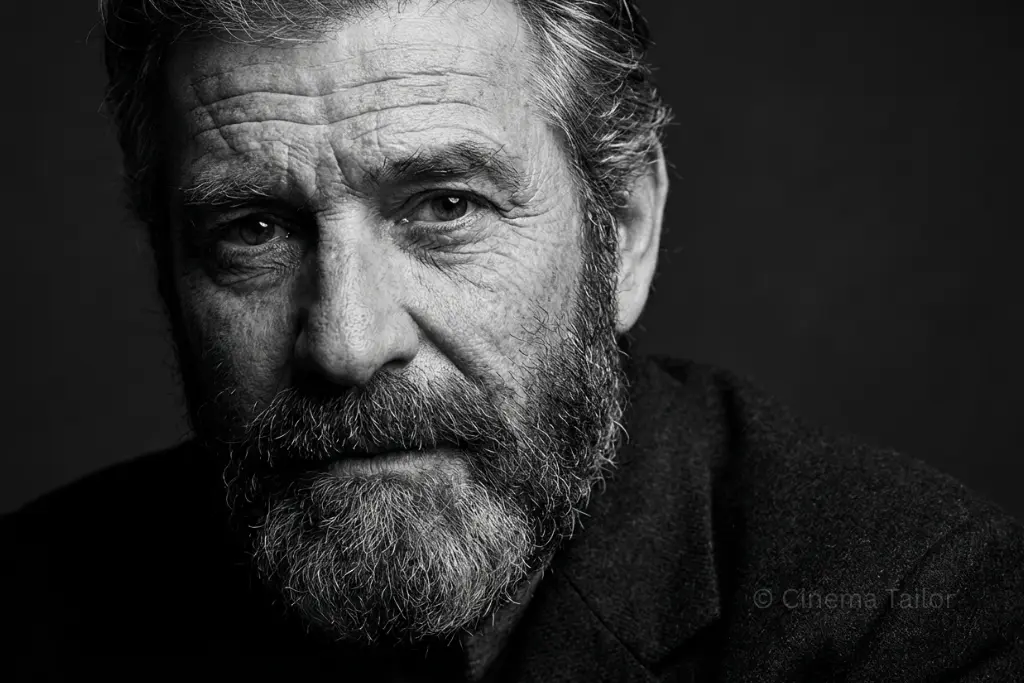
Furthermore, we must pay homage to the beard. A mature, well-groomed beard is the final seal of masculinity. It acts as a natural contour, adding structural weight to the jawline and serving as a textured testament to a man’s unyielding nature. These three elements—silver hair, deep wrinkles, and a seasoned beard—are not flaws to be hidden, but the highest honors bestowed by time, turning a man into an immovable monument of experience.
Case Study: The Raw Masculinity of ‘Sicario’
While tailored suits represent refined maturity, the film Sicario (2015) offers a masterclass in a different kind of Aging Classic: Raw, Macho Maturity. Through Josh Brolin and Benicio del Toro, we see how age manifests as an immovable force of nature.
Josh Brolin – The Rugged Pragmatism
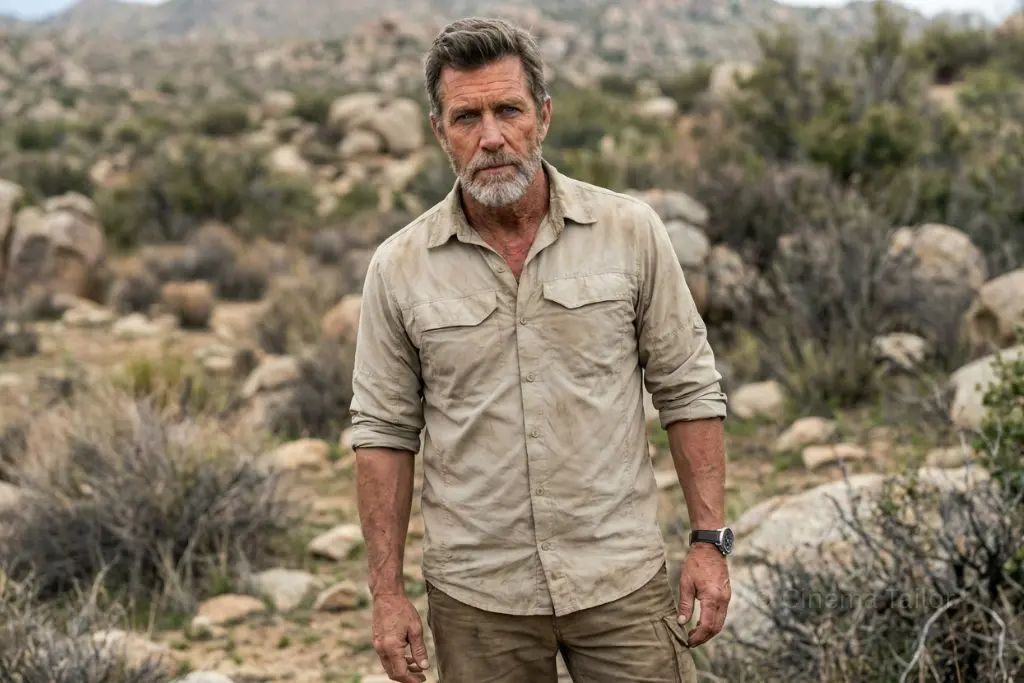
In Sicario, Josh Brolin (as Matt Graver) embodies a man who has replaced vanity with utility. His Aging Classic Style isn’t about fashion; it’s about Efficiency. The grey in his beard and the weathered texture of his skin suggest a man who has seen everything and survived. This is a crucial lesson for the Cinema Tailor: maturity allows a man to wear rugged, unpolished fabrics like heavy cotton and canvas with an authority that a younger man simply cannot muster. He doesn’t dress to be seen; he dresses to operate.
Benicio del Toro – The Silent Storm
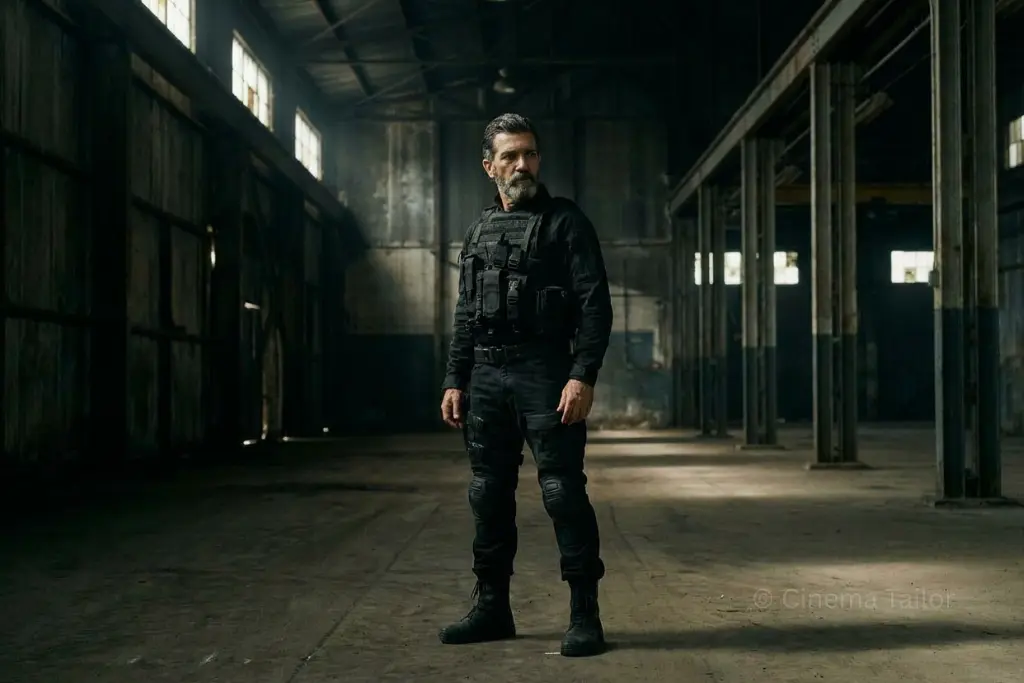
Benicio del Toro’s Alejandro is the epitome of “The Architect of Revenge.” His style proves that Aging Classic maturity isn’t about muscles; it’s about the intensity in the eyes and the stillness of the posture. Del Toro wears his age like a shadow, reminding us that as a man grows older, his most powerful outfit is his silence and his unwavering focus. His wardrobe is simple—dark, muted, and blending into the environment—yet his presence is deafening.
Cinematic Case Studies: Men Who Mastered the Clock
Daniel Craig – The Evolution of Resilience
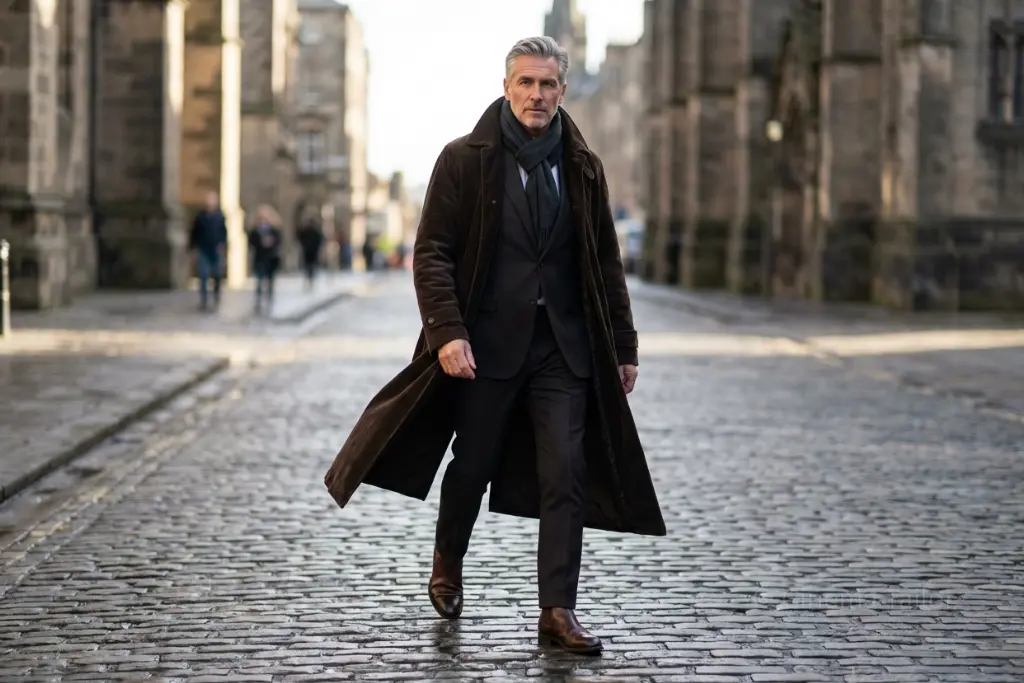
Compare Daniel Craig in Casino Royale (2006) to his final appearance in No Time to Die (2021). While he was physically at his peak in the former, his style in the latter possessed a weathered elegance that was far more captivating. The slight graying at the temples and the deeper character lines in his face made the Massimo Alba corduroy duster coat look like armor earned through battle. This is the Aging Classic Style at its peak—where the clothing absorbs the character of the wearer.
Beyond Daniel Craig’s seasoned elegance, discover how technical mastery defines a character’s cinematic aura in our deep dive:
The Secret Physics of the John Wick Suit: A Masterclass in Cinematic Tailoring.
George Clooney – The King of Sprezzatura
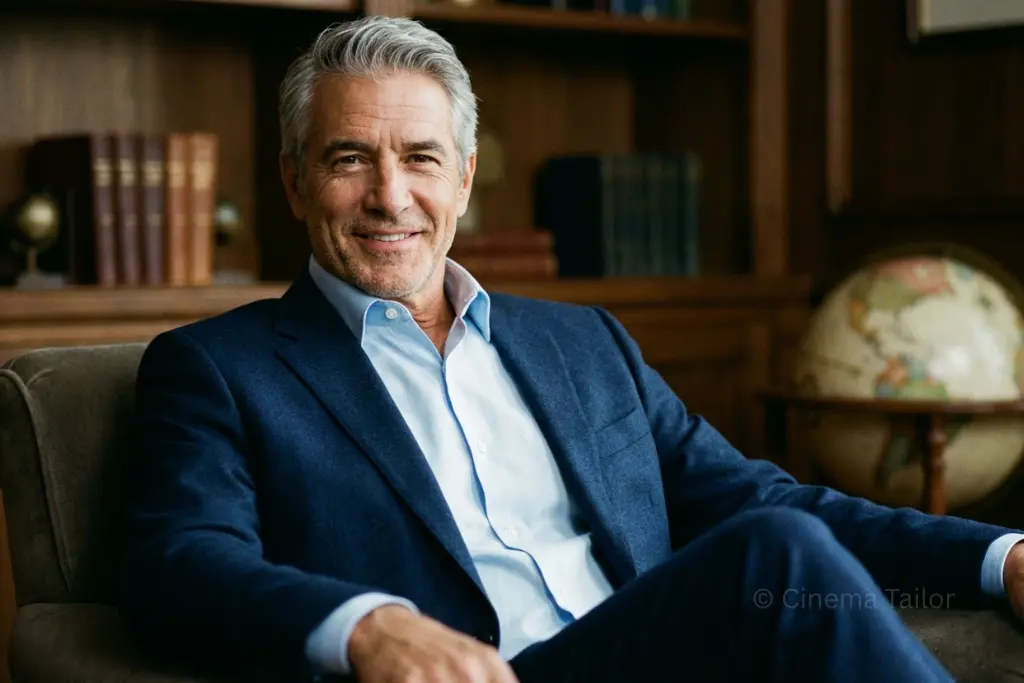
George Clooney is perhaps the modern poster child for aging gracefully. He embraced his “Silver Fox” status early on, utilizing a color palette of charcoal and midnight navy to complement his hair. His style in movies like The American showcases the power of minimalism. By stripping away unnecessary accessories and focusing on the architecture of the suit, he proves that a man’s presence should always be louder than his clothes.
James’s Perspective: Embracing the Aging Classic Style
There was a time in my early thirties when I believed authority was something that had to be shouted through high-contrast shirts and aggressive patterns. I thought being “stylish” meant being noticed. But as I embraced the Aging Classic Style, I realized that the noise of my clothing was actually drowning out my presence.
When I made the transition—reducing my palette to charcoal and navy, and choosing the heavy drape of flannel over lightweight wool—the room changed. It wasn’t just about the fabric; it was about the stability I projected. I no longer needed to perform. People began to listen more intently, not because I was louder, but because I looked like a man who had already won the battles they were still fighting. This is the true power of Cinema Tailor—it’s about directing the perception of your own maturity.
Technical Superiority: The Engineering of Aging Classic Style
As the body changes, the requirements of the tailor change. This is where the true “Tailor’s Art” shines. It is no longer about following the body, but about creating an architecture of power.
Fabric Choice: The Weight of Authority
A true Aging Classic Style relies on fabrics with Substance. Heavy Flannel, Tweed, and Hopsack provide a natural drape that masks minor postural changes and adds a physical “weight” to one’s presence. In the movie The Untouchables, the heavy overcoats worn by Sean Connery gave him a grounded, immovable aura. These fabrics hold their shape, ensuring that the silhouette remains sharp even as the world around it becomes chaotic.
The Architecture of the Shoulder
A structured shoulder acts as a frame for the face. As we age, maintaining a sharp silhouette becomes a matter of engineering. A master tailor uses padding and canvas to restore the heroic proportions that time might have softened. Whether it is a subtle Spalla Camicia or a more structured British shoulder, the goal remains the same: to create a visual boundary of authority.
Conclusion: The Final Act of Aging Classic Style
The narrative of the “fading” older man is a myth. In the world of cinema and style, the final act is often where the character finds his greatest strength. Whether it’s the refined elegance of a Bond or the rugged, macho authority of the men in Sicario, the message is clear: Time is a man’s ally, not his enemy.Aging Classic Style is your visual armor, and as the armor gains scars and history, it only becomes more valuable. By embracing the principles of Cinema Tailor, you are directing your own story. You aren’t just getting older; you are becoming a more stable, more powerful version of yourself.
James is a UI software expert with over 20 years of experience in the IT industry.
He is the editor of Cinema Tailor, where he analyzes cinematic style and visual storytelling through a structured, system-level perspective.