
Introduction: When Seconds Count and Help is Minutes Away
Are you standing in front of your mirror, imagining a suit that could stop a bullet? In 2026, this isn’t a “Kingsman” fantasy; it’s a calculated response to a changing world. We live in an era where urban unpredictability is increasing, and the physical reality of emergency response times means there is always a critical gap between a threat and protection.
The message is clear: when seconds count, the traditional safety nets are often minutes away. This isn’t a critique of the system; it’s an acknowledgement of its inherent physical limits. In this landscape, Body Armor has evolved from niche tactical gear into a mandatory redundancy for the modern individual. It is about reclaiming your sartorial authority and ensuring that your personal “security architecture” is robust enough to handle the unexpected.
James’s Perspective: Why I View Body Armor as Critical Infrastructure
In 20 years of analyzing systems, I’ve learned that the most critical security is the one you never see—until it saves everything. To me, a bespoke suit is the User Interface (UI), while Body Armor is the Backend Infrastructure. Integrating armor into your wardrobe is “Hardening” your most important endpoint: yourself. However, a system that is too rigid breaks under pressure. True robustness comes from adaptation. The challenge is securing your “backend” without losing the “elasticity” of your movement. In high-stakes moments, this invisible security is what allows you to maintain a sharp, unwavering focus.
The Practical Arsenal: Real-World Body Armor Solutions
Forget the movies. In the real world, you can’t wear a tank under a suit. You need solutions that work in daily life. Here is the hardware available for personal deployment in 2026.
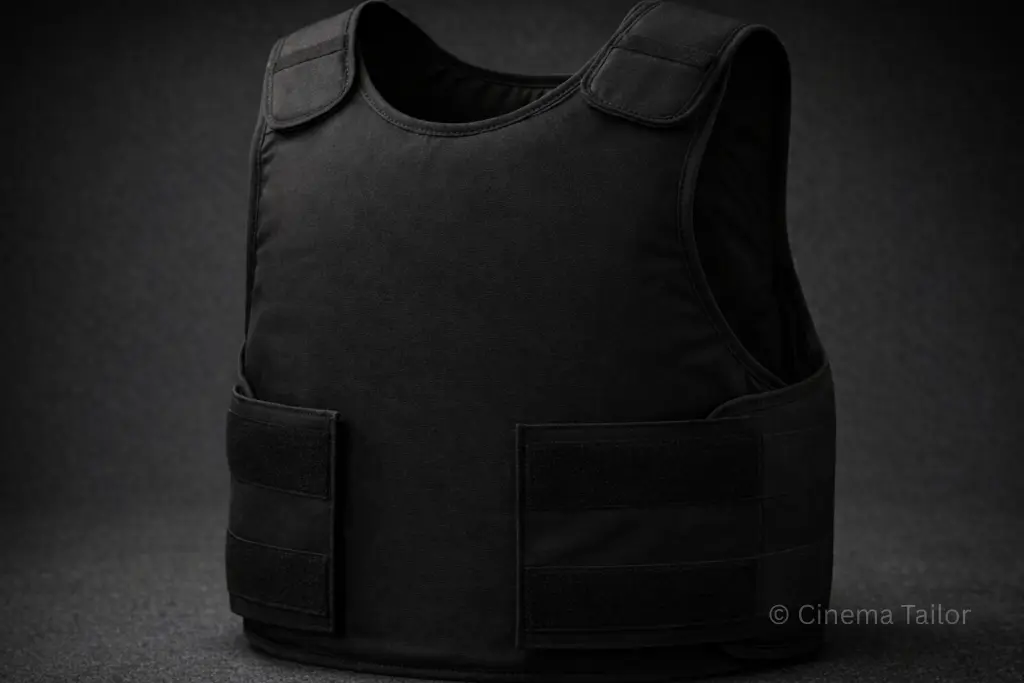
1. The “Ghost” Vests (NIJ Level II / IIIA)
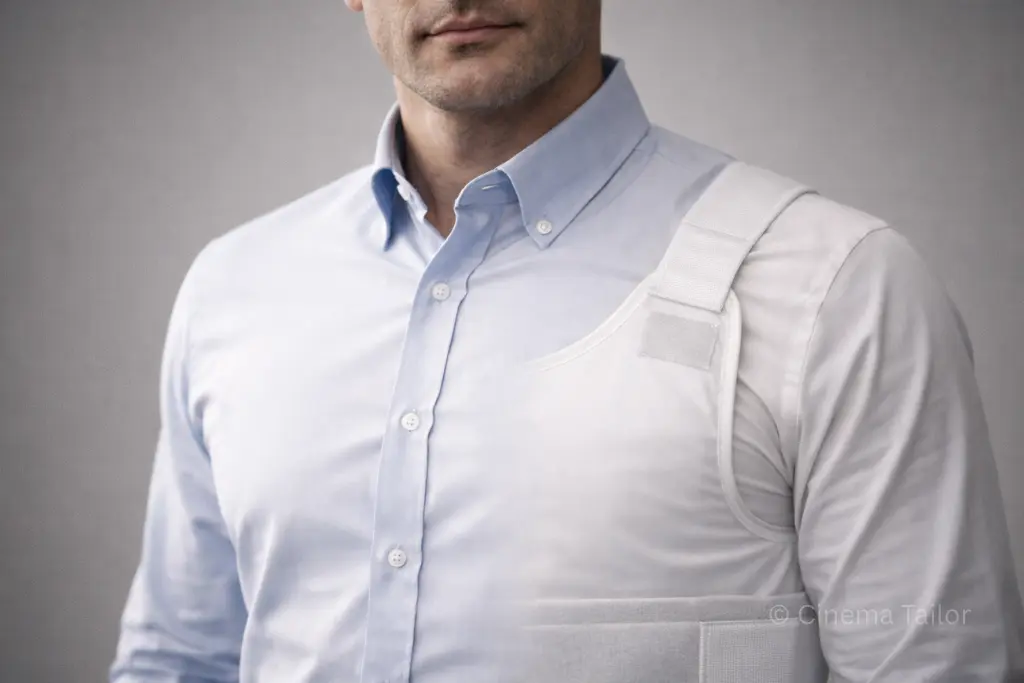
These are the gold standard for discreet protection. Ultra-thin Body Armor vests from top-tier manufacturers are now less than 5mm thick.
- The Advantage: It is virtually invisible. It maintains the precision of your bespoke tailoring.
- The Reality: Physics cannot be cheated. It will stop the round, but the impact energy will still be felt. This is a tool for survival.
2. Tactical Integration: Ballistic Suit Panels
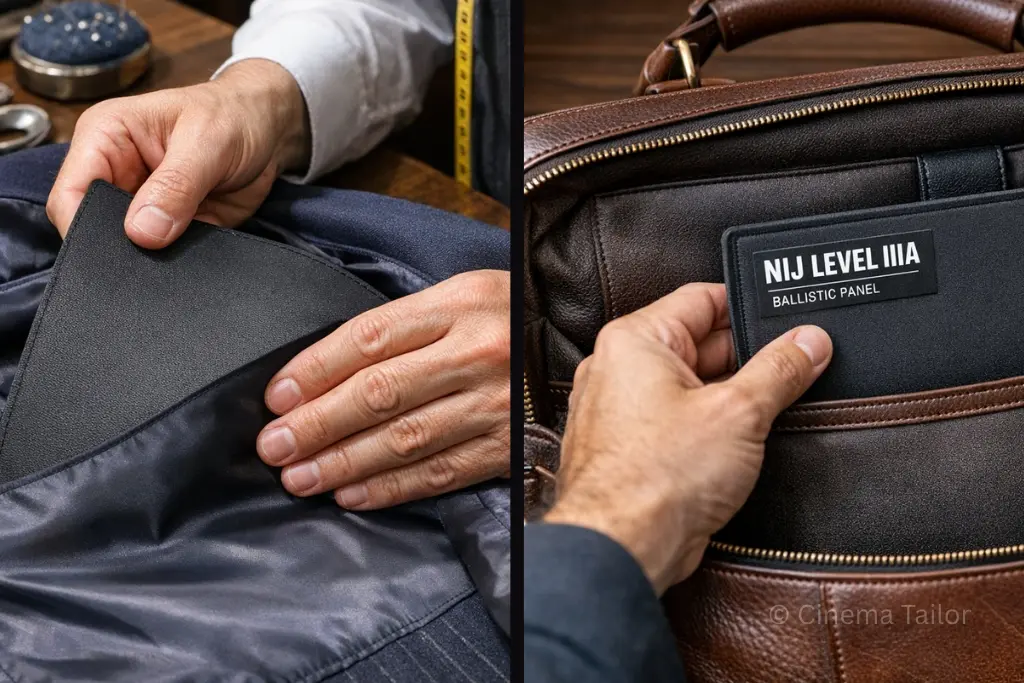
For the purist who refuses a vest, there is an approach that involves sewing flexible Body Armor panels directly into the jacket’s architecture.
- Hardware: High-density UHMWPE (Ultra-High-Molecular-Weight Polyethylene) panels.
- James’s Warning: I call this a “perimeter defense.” It protects the chest and back, but creates a “Single Point of Failure” if the jacket is unbuttoned. It is a calculated trade-off between comfort and coverage.
3. Passive Defense: The Ballistic Backpack Shield
The ballistic backpack insert is an underrated security tool. These Level IIIA inserts turn any standard briefcase into a portable shield.
- James’s Analysis: This is “Passive Defense.” It’s a fail-safe you carry. In an emergency, it provides a 10×12 inch zone of safety that can be deployed instantly.
To understand why Kingsman-style suits remain a fantasy compared to the real-world gear discussed here, read:
The Secret of Modern Armor: Why Kingsman’s Bulletproof Suit is a Beautiful Fantasy
The Civilian Shield: Real-World Resilience in Nobody

While police thrillers show the professional side, the film Nobody (2021) provides the most visceral look at Body Armor in a civilian context. The protagonist, Hutch Mansell, navigates a brutal home invasion and a final warehouse showdown not as a superhero, but as a man who understands the “layered security” of a physical system. In the climax, we see him layered in a standard suit jacket over a discreet ballistic vest, absorbing the kinetic impact of close-range gunfire. It isn’t about invincibility—it’s about “system redundancy.” The armor allows him to stay in the fight long enough to execute his strategy. This mirrors the real-world application of Body Armor for individuals who prioritize discreet safety while maintaining a completely non-tactical, “gray man” appearance in high-threat urban environments.
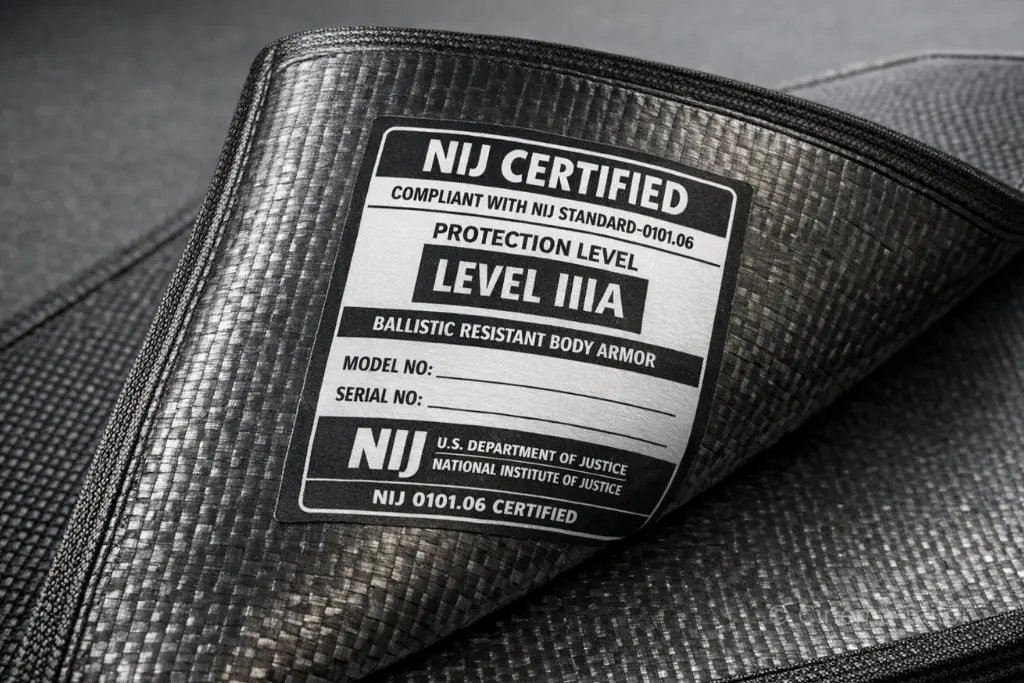
NIJ Standards: Decoding the Ballistic Encryption
Understanding Body Armor levels is like choosing encryption bit-depth. You match the defense to the threat.
| Protection Level (NIJ) | Threat Coverage | Practical Use Case |
| Level IIA | Low-velocity handguns | Maximum concealment for daily use |
| Level II | Standard 9mm, .357 Mag | Best balance for urban transit |
| Level IIIA | .44 Magnum, SMGs | The industry standard for high-risk zones |
| Level III | High-velocity rifles | Requires rigid plates; difficult to hide |
| Level IV | Armor-piercing rounds | Extreme protection; ruins any silhouette |
Material Engineering: The War Between Protection and Drape
When engineering a garment, there is a constant battle between protection and “Drape.” A suit must flow; Body Armor is inherently rigid. Modern UHMWPE fibers are the current “stable build,” but the future lies in nanotechnology.
Carbon nanotubes and graphene-infused silk are the “Next-Gen OS” of armor. They promise the flexibility of a standard shirt with the protection of a vest. Until then, we rely on the most advanced flexible polyethylenes to bridge the gap between sartorial elegance and life-saving hardware.
FAQ: Frequently Asked Questions About Body Armor
Q1. Is Body Armor truly “bulletproof”? Technically, no. We use the term “bullet-resistant.” Even if a vest stops a bullet, the kinetic energy is transferred to your body. Think of it as a crash-test; the car is wrecked, but the passenger survives.
Q2. Can I wear Body Armor on an airplane? In 2026, most domestic flights allow you to wear or carry soft Body Armor in your luggage, but international laws vary wildly. Always check the TSA and local regulations of your destination before departure.
Q3. Does Body Armor protect against knives? A standard ballistic vest is designed to catch a bullet, not stop a sharp point. For protection against blades, you need a “Multi-Threat” or “Spike-rated” vest, which has a much tighter, different weave.
The Personal Safety Checklist: James’s Strategic Approach
Before deploying your physical security system, run through this checklist to ensure your Body Armor strategy is complete:
- [ ] Threat Assessment: Have you identified the most likely threat in your environment (handgun vs. sharp object)?
- [ ] Concealability Check: Does the vest ruin your silhouette? If it’s visible, it escalates the situation.
- [ ] Environmental Suitability: Can you wear this for 8+ hours in your current climate? Heat exhaustion is a real threat.
- [ ] Trauma Pad Integration: Do you have trauma pads behind your ballistic plates to prevent “Backface Deformation” (broken ribs)?
- [ ] Legal Compliance: Have you checked the local 2026 statutes regarding civilian ownership of Body Armor in your jurisdiction?
- [ ] Mental Hardening: Are you training your situational awareness? No amount of Kevlar can replace a calm, strategic mind.
Conclusion: Be the Monument, Not the Fortress
After 20 years of analyzing systems, I’ve realized that the strongest system is the one that doesn’t need to be hit to prove its worth. Use Body Armor as a tool if your environment demands it, but never let it become a substitute for your inner character. The most powerful people I have known didn’t rely on Kevlar; they relied on their ability to move with unwavering confidence.
Be the monument.

James is a UI software expert with over 20 years of experience in the IT industry.
He is the editor of Cinema Tailor, where he analyzes cinematic style and visual storytelling through a structured, system-level perspective.