
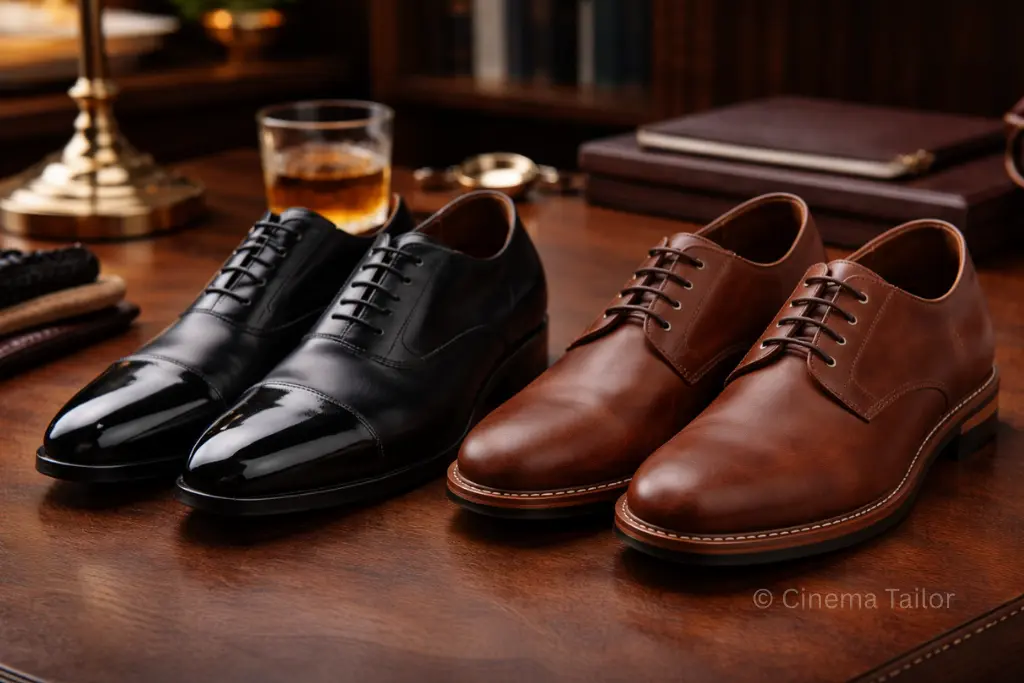
In the binary world of high-stakes leadership, ambiguity is a system failure. When you step into a boardroom, an M&A negotiation, or a global summit, your identity is scanned before you even speak. If your suit is the User Interface (UI), your shoes are the Core Drivers. A mismatch here doesn’t just look bad—it creates a “Security Breach” in your perceived authority.
Today, we deconstruct the ultimate sartorial choice: Black Oxford vs. Brown Derby. This isn’t just a fashion debate; it’s a tactical analysis of the architecture of dominance.
James’s Perspective: The Zero-Trust Architecture of Footwear
Having spent 20 years in the IT trenches and the C-suite, I’ve learned that a system’s integrity is only as strong as its most overlooked component. In a Zero-Trust environment, we verify everything. In the boardroom, I apply the same logic to footwear. Brogues are “visual noise”—unnecessary ports that invite distraction. Closed Lacing is a secure, encrypted protocol. Your Vamp is the hardware that must withstand the pressure of a 14-hour production run. If you want to lead, you must ensure your “boot sequence” is flawless.
1. The Logical Foundation: Understanding the Architecture
To choose correctly between a Black Oxford and a Brown Derby, you must understand their underlying code.
The Oxford: The Closed Source Protocol
The Oxford is defined by its Closed Lacing system. In this architecture, the eyelet flaps are sewn under the vamp. When the laces are tightened, the flaps meet in a seamless, rigid line. This isn’t for comfort; it’s for Structural Integrity. It is the most formal footwear protocol in existence. It says, “My world is organized, disciplined, and impenetrable.”
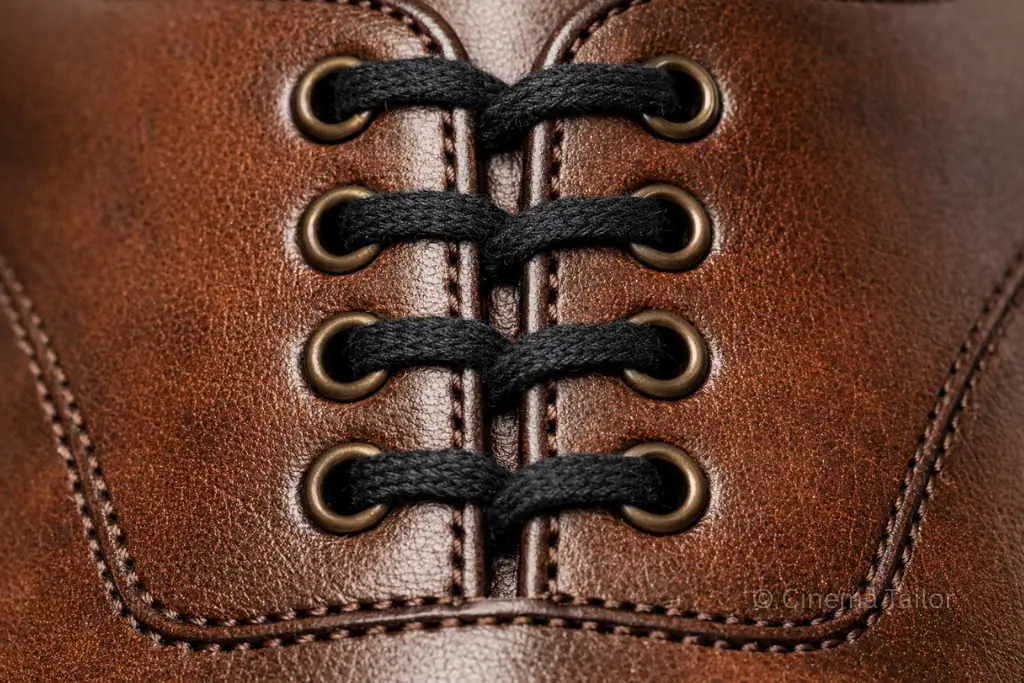
The Derby: The Open API
The Derby utilizes an Open Lacing system, where the eyelet flaps are sewn on top of the vamp. This allows the flaps to swing open, providing more volume and a “flexible interface” for the foot. While this offers higher scalability for different foot shapes and casual environments, it lacks the surgical precision of the Oxford. It is the footwear equivalent of an Open-Source platform—accessible and versatile, but not always suitable for mission-critical, high-security formal environments.
2. The Elimination of Visual Noise: Why “No Brogues”?
In the Kingsman Protocol, the rejection of the Brogue is a mandatory firewall.
The Legacy of the Brogue
Brogues, characterized by their decorative perforations, were originally designed as “Drainage Ports” for Irish marshes. They were functional equipment for the working class to trek through mud. In a modern corporate skyscraper, there is no mud. Therefore, those holes are nothing but Visual Noise.
Tactical Purity
When you choose a plain-toe or cap-toe Oxford with No Brogues, you are projecting Tactical Purity. You are telling your interlocutor that you don’t need decorative “bloatware” to hide structural weaknesses. You are the signal, not the noise. In the elite circles of London or New York, a clean black Oxford is the silent password that grants you “Root Access” to the room.
For a deeper dive into the specific rules that define the Kingsman’s choice of footwear, see our comprehensive guide on
Oxfords, Not Brogues: The Ultimate Guide to Footwear Etiquette.
3. Cinematic Case Study: Kingsman vs. Peaky Blinders

Kingsman: The Final Requirement
In Kingsman: The Secret Service, Harry Hart (Colin Firth) famously mandates: “Oxfords, not Brogues.” This isn’t a suggestion; it’s a system requirement for joining the most elite intelligence circle on Earth. The Oxford’s Closed Lacing mirrors the secrecy and discipline of the agency. It is the final mark of a gentleman-spy. Without it, you are just an amateur in a costume.
Peaky Blinders: The Scalability of the Derby
Contrast this with Thomas Shelby in Peaky Blinders. Operating in the “Live Production Environment” of industrial Birmingham, Shelby relies on Derby boots. His life is messy, violent, and requires constant pivoting. The Derby’s open structure provides the scalability needed for his boots to function in both the mud of the streets and the marble of his rising empire. He is a disruptor, and his footwear reflects his aggressive, agile code.
4. The Structural Core: The Vamp and Systematic Integrity
The Vamp is the most prominent part of the shoe’s upper. In my experience as a CEO, I look at a man’s shoe vamp the same way I look at a company’s quarterly reports.
- Integrity Check: A high-grade calfskin vamp should crease gracefully, like a well-optimized piece of code.
- The Crease Bug: Deep, ugly cracks in the vamp indicate a “hardware failure” in the leather quality. It shows a lack of investment in the foundations.
- The Closed Lacing Interface: The way the vamp meets the lacing system in an Oxford is a masterpiece of engineering. It creates a unified silhouette that projects absolute confidence.
5. Technical Specifications: The Footwear Comparison Table
| Feature | Black Oxford (Enterprise Protocol) | Brown Derby (Flexible API) |
| Lacing Architecture | Closed Lacing (Secure/Rigid) | Open Lacing (Flexible/Open) |
| Brogue Protocol | No Brogues (Pure Signal) | Optional (Acceptable Noise) |
| Vamp Stability | High (Systematic Integrity) | Medium (User Comfort) |
| Primary Deployment | Boardrooms, M&A, Black Tie | Business Casual, Travel, Tech Meetups |
| Authority Score | 10/10 (Absolute Dominance) | 7/10 (Approachable Leadership) |
6. Optimization: Mirror Shine and System Maintenance
A leader who neglects his shoes is a leader who neglects his logs. The Mirror Shine on an Oxford’s cap-toe is the final security patch.
- Cleansing: Removing the dust (cache) with a horsehair brush.
- Conditioning: Applying cream to keep the leather (hardware) supple.
- The High-Shine Layer: Applying layers of wax to the toe-cap.
The reflection in your shoe should be as clear as your vision for the company. When you can see your own eyes in the leather of your Closed Lacing Oxfords, you have achieved the “Mirror Shine Protocol.”
7. Q&A: Troubleshooting Your Footwear Protocol
Q1: Can I wear a Brown Derby to an IPO presentation?
A: Negative. An IPO is a high-security event. It requires the “Root Access” of a Black Oxford. Save the Brown Derby for the celebratory dinner afterwards.
Q2: Why does “Closed Lacing” feel tighter?
A: It’s by design. It’s a “Hardened System.” It’s meant to hold the foot in a disciplined position. If you want comfort over authority, stay in the “Sandbox” of a sneaker.
Q3: Does the “Vamp” quality really matter for SEO?
A: In the digital world, Google’s E-E-A-T algorithm looks for expertise. In the physical world, your peers look at the “vamp” of your character. High-quality foundations are non-negotiable in both.
8. Checklist: Final Deployment Validation
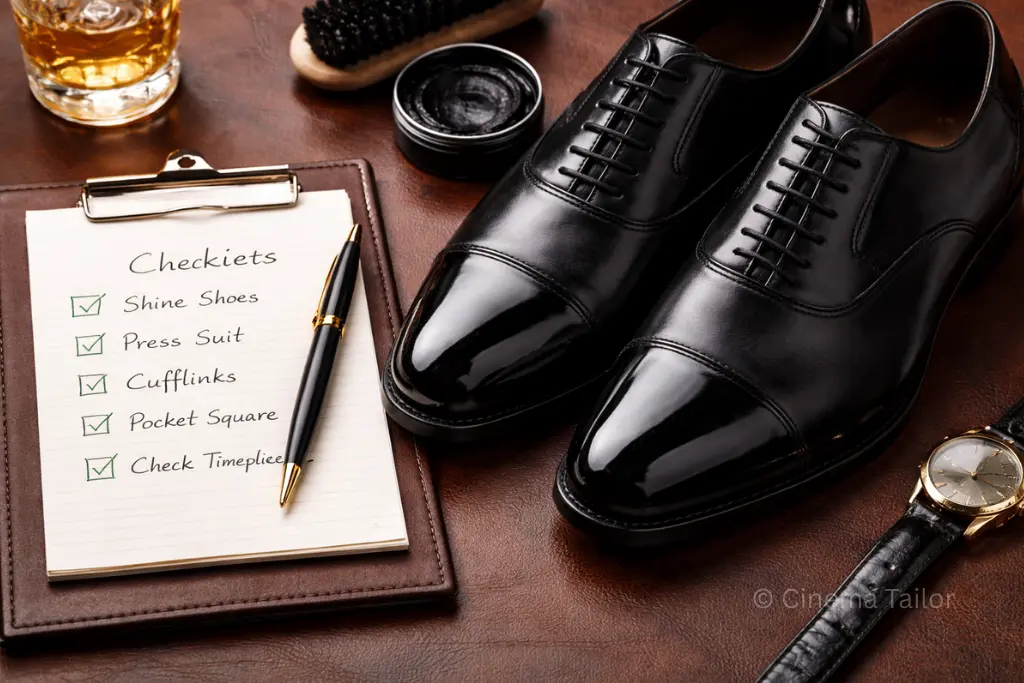
- [ ] No Brogues: Is the shoe free of visual noise and holes?
- [ ] Closed Lacing: Are the flaps perfectly aligned without a gap?
- [ ] Vamp Integrity: Is the leather smooth and well-conditioned?
- [ ] Mirror Shine: Does the toe-cap reflect your sharp mind?
- [ ] System Sync: Does the shoe color match the belt and the mission’s gravity?
Conclusion
In the end, whether you choose the Black Oxford or the Brown Derby is a matter of deployment. But for the man who seeks absolute dominance—the man who wants to live by the Kingsman Protocol—the choice is binary. The Black Oxford is the final password to the elite circle. Master the architecture of your feet, and you master the room.


James is a UI software expert with over 20 years of experience in the IT industry.
He is the editor of Cinema Tailor, where he analyzes cinematic style and visual storytelling through a structured, system-level perspective.