
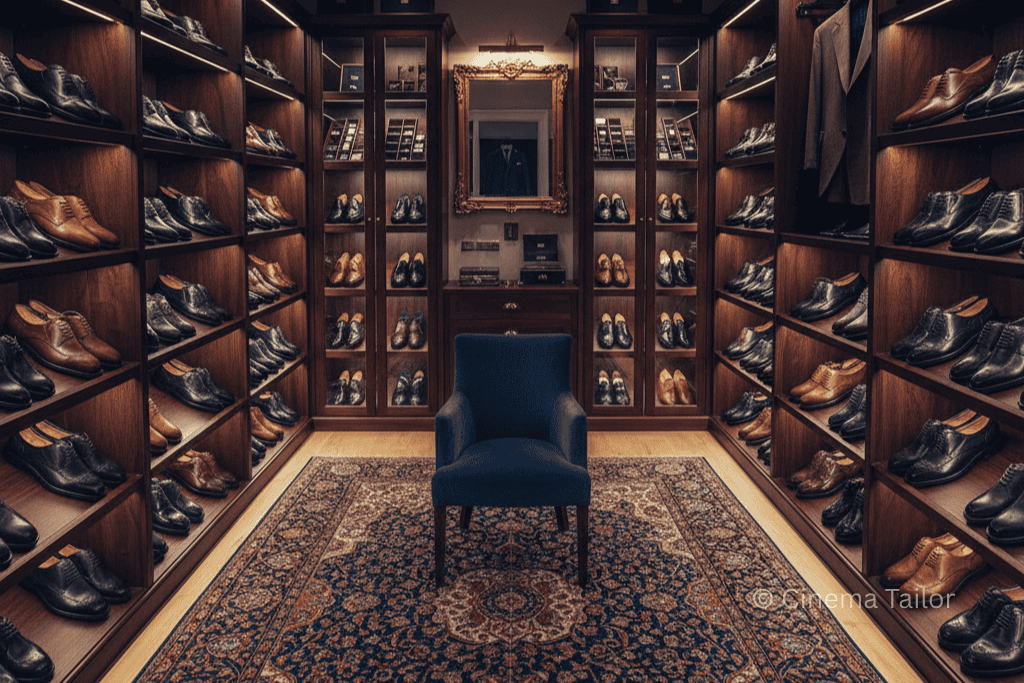
In the world of Kingsman, the phrase “Oxfords, not Brogues” is more than just a clever line of dialogue; it is a fundamental code of dress that functions as a language, a rank, and a weapon. I still remember the first time I heard Harry Hart deliver this cryptic command to his protégé, Eggsy. As someone who has spent over 20 years navigating the high-stakes software industry, I immediately recognized that this wasn’t just movie talk. It was a masterclass in strategic minimalism—the kind of silent authority required when the stakes are at their highest.
When Harry Hart guides Eggsy from the chaotic streets of London to the refined halls of Savile Row, he isn’t just changing the boy’s clothes; he is recalibrating his social frequency. But why would a world-class spy agency base its entire identity on a distinction in men’s footwear? From my perspective at Cinema Tailor, the Oxford represents a “Refined Rebellion”—a disruptive force that operates within the strict boundaries of tradition.
Today, we deconstruct the architecture, history, and etiquette of the Kingsman Oxford, and why every modern “Intellectual Alpha“ must understand the psychological power of a “clean” shoe.
1. Decoding the Oxfords Not Brogues Philosophy
To the untrained eye, all dress shoes might look the same. However, to a Kingsman, the difference is fundamental.
The Oxford is defined by its “Closed Lacing System.” This means the eyelet tabs (where the laces go) are sewn under the vamp (the front part of the shoe). This creates a sleek, seamless silhouette that hugs the foot and looks incredibly formal. A Brogue, on the other hand, refers to the decorative perforations (the little holes) punched into the leather. Historically, these holes were designed to drain water from the shoes of Scottish farmers working in bogs. Thus, “Brogues” were considered country-wear, while “Oxfords” were the uniform of the urban elite.
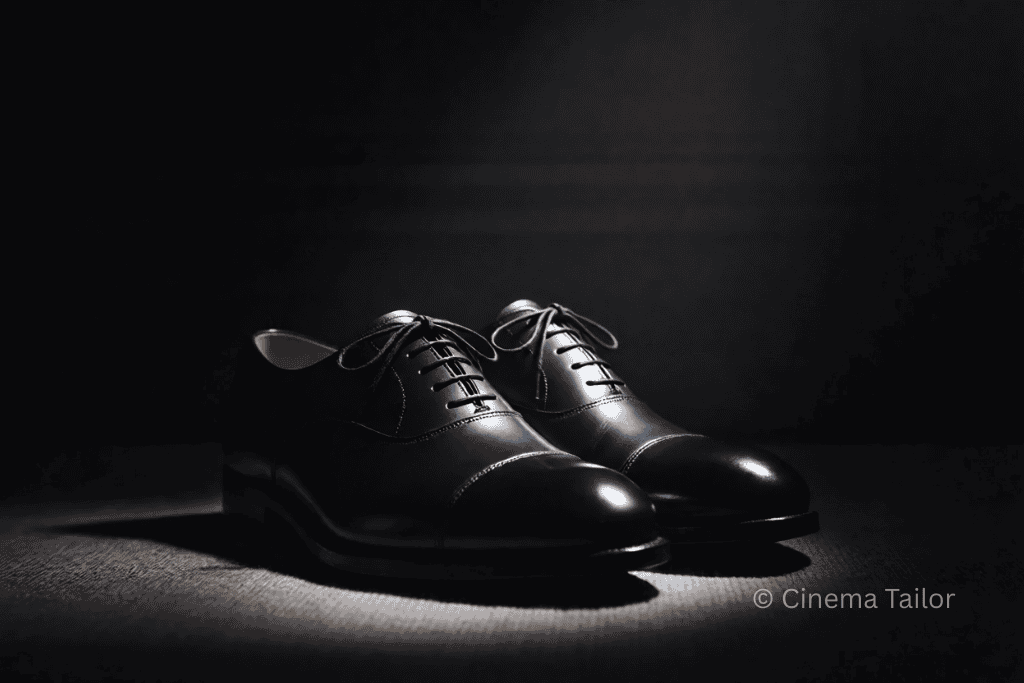
Technical Comparison: Why Construction Matters
| Feature | Oxford (The Urban Elite) | Brogue (The Rural Heritage) |
| Lacing System | Closed (Sewn under the vamp) | Open (Eyelet tabs on top) |
| Aesthetic Goal | Streamlined & Minimalist | Textured & Decorative |
| Historical Origin | Urban Universities / Formal Galas | Scottish Bogs (Water Drainage) |
| Strategic Signal | Absolute Discipline | Relaxed Approachability |
| Contextual Fit | High-Stakes Negotiations | Casual Fridays / Country Clubs |
James’ Perspective
In the software industry, we often talk about ‘clean code.’ Clean code is predictable, efficient, and devoid of unnecessary clutter. It performs its function without shouting for attention. After 20 years of leading IT ventures and navigating high-stakes negotiations from Seoul to the global stage, I’ve realized that a pair of Black Plain-Toe Oxfords is the physical manifestation of clean code in the boardroom.Choosing an Oxford over a Brogue isn’t about vanity; it’s a Strategic Directive. When I step into a meeting, I don’t want my footwear to be a distraction or a decorative noise. I want it to provide a solid, silent foundation that allows my vision and my words to take center stage. In a world full of ‘Brogue-like’ noise—excessive features and superficial flair—the Oxford represents the discipline of Strategic Minimalism.
Remember: In high-stakes environments, the loudest person in the room is rarely the one in control. The same applies to your attire. True authority whispers; it doesn’t scream.
2. The Etiquette of Understatement
The mantra “Oxfords, not Brogues” is a plea for minimalism. In the context of the Kingsman secret service, a spy must be invisible yet impeccable.
- Visual Cleanliness: The absence of broguing (perforations) creates a smooth surface that reflects light evenly. It doesn’t distract the eye; it complements the sharp lines of a double-breasted suit.
- Formal Dominance: By choosing a plain-toe or cap-toe Oxford in black calfskin, you are signaling that you respect the occasion. Whether it’s a high-stakes gala or a mission to save the world, the plain Oxford is the highest level of formal footwear.
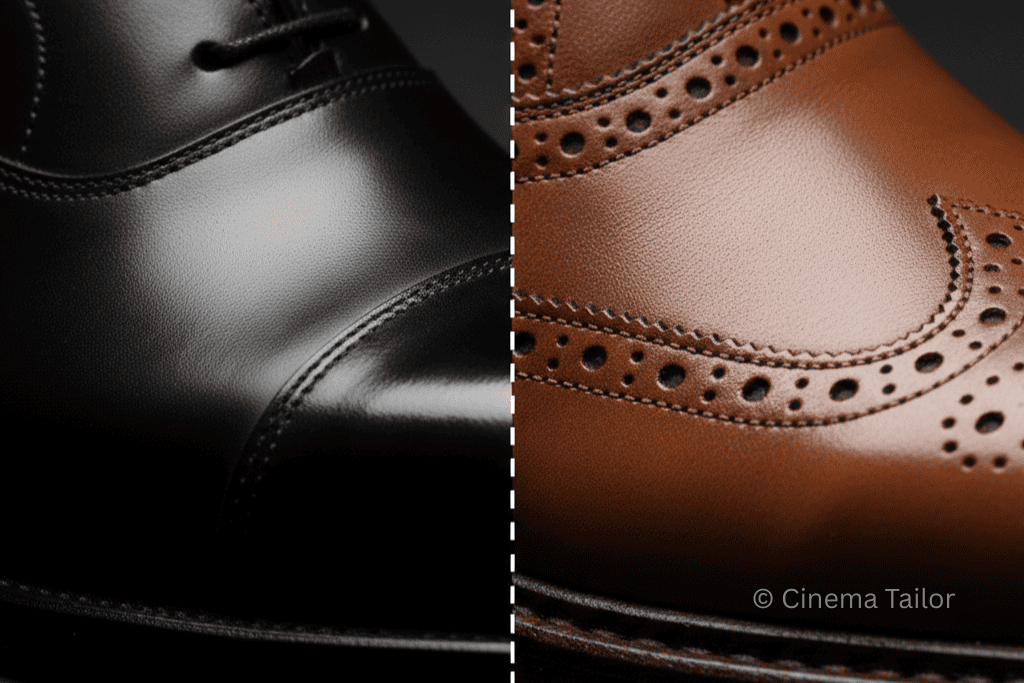
This philosophy of “Visual Cleanliness” extends into the psychological realm of power dynamics. In high-stakes environments—much like the world of international espionage—your attire should never “shout” for attention; it should command it through silence. A Brogue, with its intricate perforations, creates visual noise that draws the eye downward, breaking the vertical line of a well-tailored suit. In contrast, the plain-toe Oxford acts as a silent anchor, allowing the observer’s focus to remain on the wearer’s face and words. By choosing the most understated option, you are signaling a level of self-assurance that doesn’t require decorative validation. It is the ultimate “quiet luxury”—a subtle nod to those who know the code, while remaining invisible to those who do not.
3. Craftsmanship: The Savile Row Standard
A Kingsman shoe isn’t just a shoe; it’s a masterpiece of engineering. True luxury footwear, like those featured in the film (crafted by legendary shoemakers like George Cleverley), follows these standards:
- Full-Grain Calfskin: Only the highest quality leather is used, allowing the shoe to develop a rich patina over time while maintaining its structural integrity.
- Goodyear Welt Construction: This traditional stitching method allows the shoe to be resoled multiple times, ensuring your “armor” lasts a lifetime.
- The Hidden Blade: While we may not need a poison-tipped blade in our toe-caps, the rigidity and sharp contours of a well-made Oxford provide a sense of “groundedness” and stability that cheap alternatives lack.
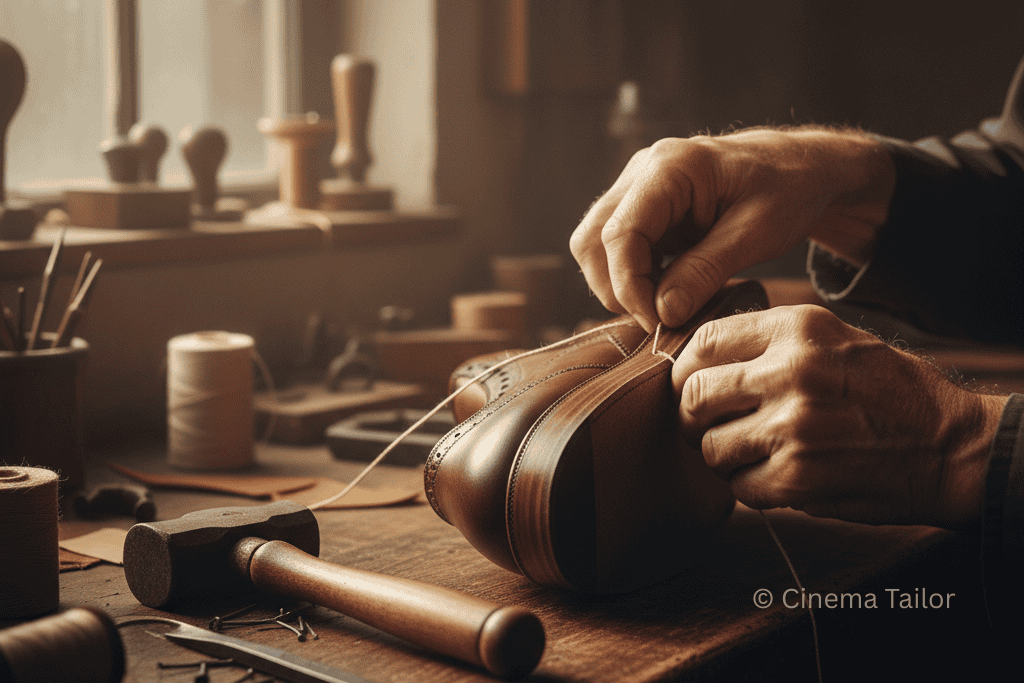
Beyond the visible leather, the true soul of a Kingsman shoe lies in its internal architecture. The Goodyear Welt is not merely a stitching technique; it is a promise of longevity. By using a strip of leather (the welt) to join the upper to the sole, a cavity is created that is filled with a cork layer. Over time, this cork molds to the unique contours of your footprint, creating a custom orthotic fit that no mass-produced shoe can replicate. Furthermore, the use of full-grain calfskin ensures that the pores of the leather remain intact, allowing the shoe to breathe and absorb polish deeply. This is why a mirror shine on a Kingsman shoe looks different—it is not a surface-level coating, but a deep, glass-like reflection built upon the highest grade of biological material available to man.
4. How to Style Your “Armor” for the Real World
If the peaked lapel suit is your shield, the black Oxford is your foundation. Here is how to wear them with authority:
- The Color Rule: For the most formal look, stick to Black. As the Kingsman code implies, a black cap-toe Oxford is the only choice for a navy or charcoal suit.
- The Shine: A gentleman’s shoes must always be polished to a mirror shine. This isn’t vanity—it’s discipline.
- The Fit: Because of the closed lacing system, Oxfords are less forgiving for those with high insteps. Finding the right “last” (the shape of the shoe) is the difference between a spy who can run and one who is hobbled by his own elegance.
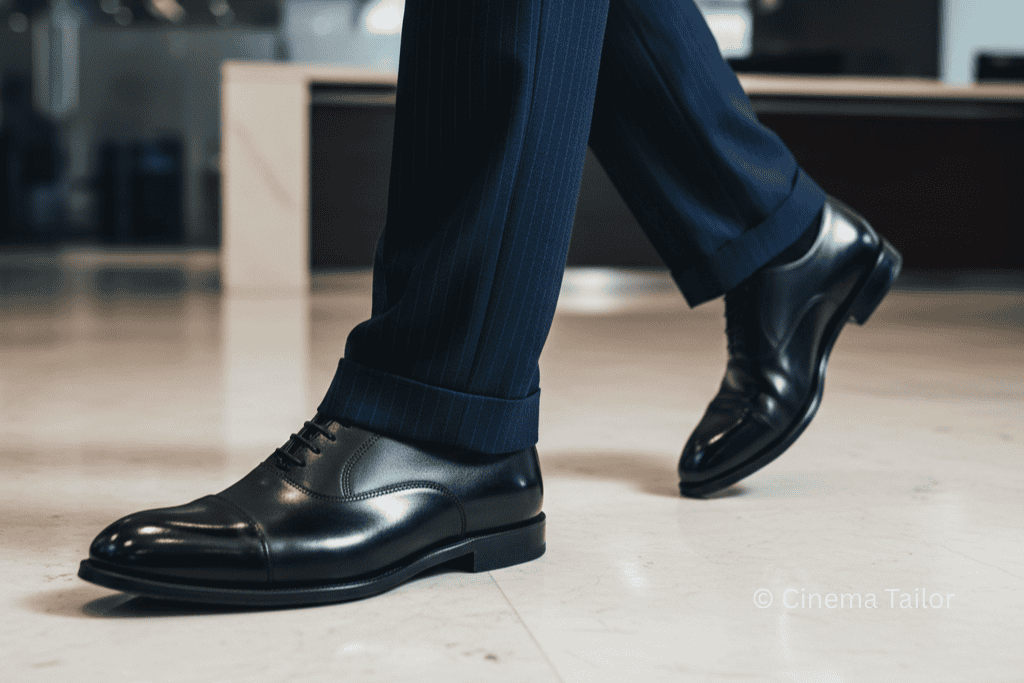
Mastering the “Shine” and the “Fit” requires more than just an occasional brush; it requires a ritualistic approach to maintenance. For the Kingsman, the mirror-shined toe cap (or ‘glaceage’) serves as a literal reflection of one’s attention to detail. This process involves the patient application of beeswax and water in microscopic layers, a task that demands the same discipline as field training. Additionally, when considering the “Last” of the shoe, one must understand that a professional fit should feel like a firm handshake—supportive but not suffocating. A properly fitted Oxford should allow for the closed lacing system to form a perfect ‘V’ or a tight parallel line, signifying that the volume of the shoe is perfectly calibrated to the wearer’s foot. This synergy between man and machine is what transforms a piece of leather into a true instrument of authority.
The Strategic Hierarchy of Business Footwear
| Occasion | Recommended Shoe Type | Psychological Impact |
| High-Stakes Negotiation | Black Plain-Toe Oxford | Projects unwavering authority and focus. |
| Boardroom Presentation | Black Cap-Toe Oxford | Signals professional integrity and discipline. |
| Client Dinner (Semi-Formal) | Dark Brown Wholecut Oxford | Represents refined taste without aggression. |
| Casual Friday / Networking | Quarter Brogue or Derby | Suggests approachability and creative flair. |
| Black Tie Event | Patent Leather Oxford | Demonstrates respect for tradition and ritual. |
5. Frequently Asked Questions: Mastering the Kingsman Footwear Etiquette
Q1: Is it ever appropriate for a CEO to wear Brogues in a formal negotiation?
James’s Insight: While “Oxfords, not Brogues” is the gold standard for absolute authority, a Quarter Brogue (minimal decorative holes) can be worn to signal approachability in a less aggressive networking environment. However, in high-stakes software compliance audits or final contract signings, I always revert to the Plain-Toe Oxford. It minimizes visual noise and ensures the focus remains entirely on the data and the deal.
Q2: Can I wear Oxfords with a Business Casual outfit?
James’s Insight: Yes, but with caution. A dark brown or tan Oxford can pair beautifully with high-quality chinos or tailored trousers. However, wearing black patent leather Oxfords with jeans creates a ‘system error’ in your visual presentation. As we say in IT, compatibility is key. Always ensure the formality of your footwear matches the architecture of your entire ensemble.
Q3: Why is the ‘Closed Lacing System’ considered more formal than ‘Open Lacing’?
James’s Insight: It comes down to Technical Integrity. The closed lacing of an Oxford provides a continuous, uninterrupted line from the toe to the ankle. This sleekness represents a higher level of discipline and manufacturing precision. In the world of elite dress codes, the more ‘hidden’ the mechanics (like the eyelet tabs), the more sophisticated the result.
6. The Executive’s Footwear Checklist: Are You Kingsman-Ready?
- [ ] The Lacing Binary: Is it a Closed Lacing Oxford?
- [ ] Zero Visual Noise: Have decorative perforations been minimized for the occasion?
- [ ] The Mirror Shine: Is the toe cap reflective and polished?
- [ ] Architectural Compatibility: Does the shoe match the formality of the suit?
7. Conclusion: Stepping Into the Legacy
Ultimately, the mantra “Oxfords Not Brogues” is more than a line from a movie; it is a fundamental principle for the modern gentleman. By prioritizing the clean silhouette of the Oxford over the decorative flair of the Brogue, you are choosing a Silent Authority that speaks volumes in any professional or social setting.
At Cinema Tailor, we believe that understanding these subtle nuances of craftsmanship and etiquette is what transforms clothing into armor. Throughout my career and my studies of cinema, I’ve learned that real influence is whispered, not shouted.
As you step out in your mirror-shined Oxfords, remember that you are not just wearing a shoe—you are upholding a legacy of discipline, tradition, and quiet power. Step wisely. The world is watching, but they shouldn’t hear you coming.
This article supports Cinema Tailor’s ongoing exploration of discipline and authority. The philosophical context is outlined in A Man’s Suit Is His Armor: The Architecture of Authority.
For the cinematic origin of this rule, see The Double-Breasted Suit: Why the Kingsman’s ‘Modern Armor’ is Still Invincible.

James is a UI software expert with over 20 years of experience in the IT industry.
He is the editor of Cinema Tailor, where he analyzes cinematic style and visual storytelling through a structured, system-level perspective.