
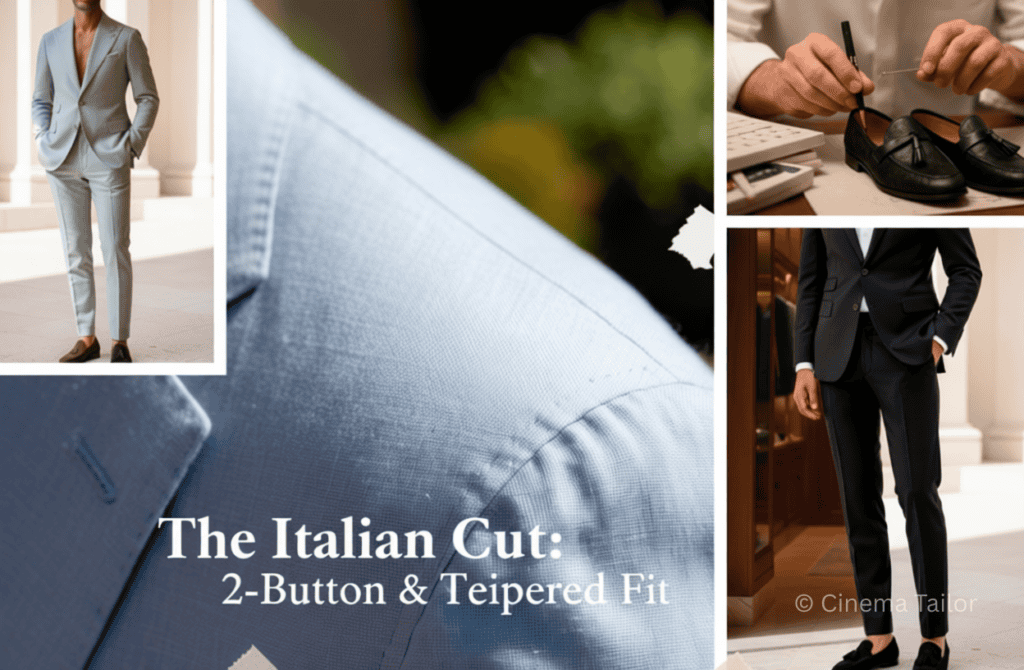
When we think of “Sexiness” in menswear, one country immediately comes to mind: Italy. From the cobblestone streets of Florence to the sun-drenched coast of Naples, Italian men possess an effortless elegance known as Sprezzatura. But what exactly makes the Italian suit style so different from the rigid structures of British tailoring or the boxy, unoptimized templates of the American sack suit?
The secret is not found in the brand label, but in the silhouette. Specifically, it is the strategic combination of the Two-Button Jacket and the Tapered Fit. In this guide, presented by Cinema Tailor, we will deconstruct the anatomy of the Italian suit and explain why this specific “hardware configuration” is the ultimate upgrade for the modern professional wardrobe.
James’s Perspective: The Agile Architecture
In my 20 years of designing and managing complex IT systems as a CEO, I’ve learned one universal truth: “The most resilient systems are born from the most flexible architectures.”
Many executives mistakenly believe that authority requires a rigid, “Legacy System” approach—stiff British tailoring that acts more like a cage than a suit. But in the modern business theater, where unpredictability is the only constant, a leader requires Agile Mobility. The Italian suit is not just a style; it is an Optimized Interface.
- Low Latency: The soft shoulders and lightweight canvas remove physical friction. Your movement and intent are transmitted with zero lag.
- Reduced Visual Noise: The tapered silhouette eliminates excess fabric. By streamlining the profile, you force the observer’s focus onto your core message, much like a clean, high-conversion dashboard.
- Hardware Elasticity: The philosophy of Sprezzatura acts as a “Fault Tolerant” system. By appearing effortlessly elegant rather than anxiously precise, you project a psychological firewall that suggests you are never overwhelmed by the crisis at hand.
Choosing the Italian style is a public declaration that you are an Agile Leader. You aren’t a slow-moving armored vehicle; you are a high-performance machine optimized for speed and precision.
Choosing the Italian style is a public declaration that you are an Agile Leader. You aren’t a slow-moving armored vehicle; you are a high-performance machine optimized for speed and precision.
British vs. Italian Suits: What is the Difference?
Before diving into the details, it is crucial to understand the philosophy behind the cut.
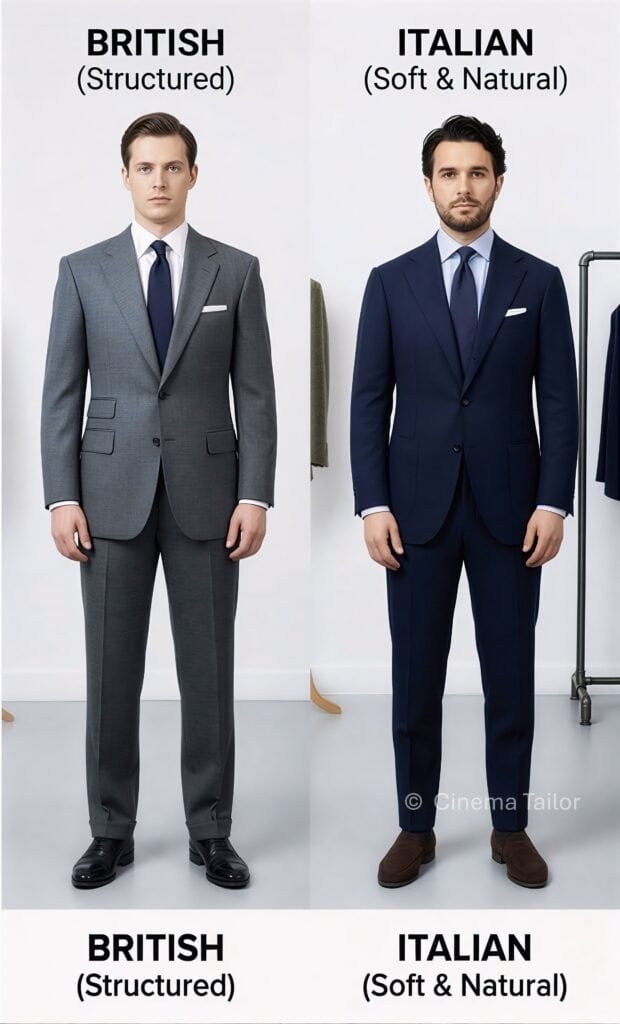
- British Style (Savile Row): Structured, padded shoulders, heavy fabrics. It is like “Armor” designed to give you authority.
- Italian Style (Neapolitan): Soft, unstructured shoulders (Spalla Camicia), lightweight fabrics. It is like a “Second Skin” designed to give you freedom and elegance.
While British suits say “I am working,” Italian suits say “I am enjoying life.”
To see how these Italian tailoring principles are applied in high-stakes tactical environments, check out our analysis on The Secret Physics of the John Wick Suit: Neapolitan Tailoring Mastery
The Jacket: Why “Two-Button” is the Italian Suit Style
If you look closely at modern Italian tailoring, you will notice that the Single-breasted, Two-button jacket is the dominant choice. Why?
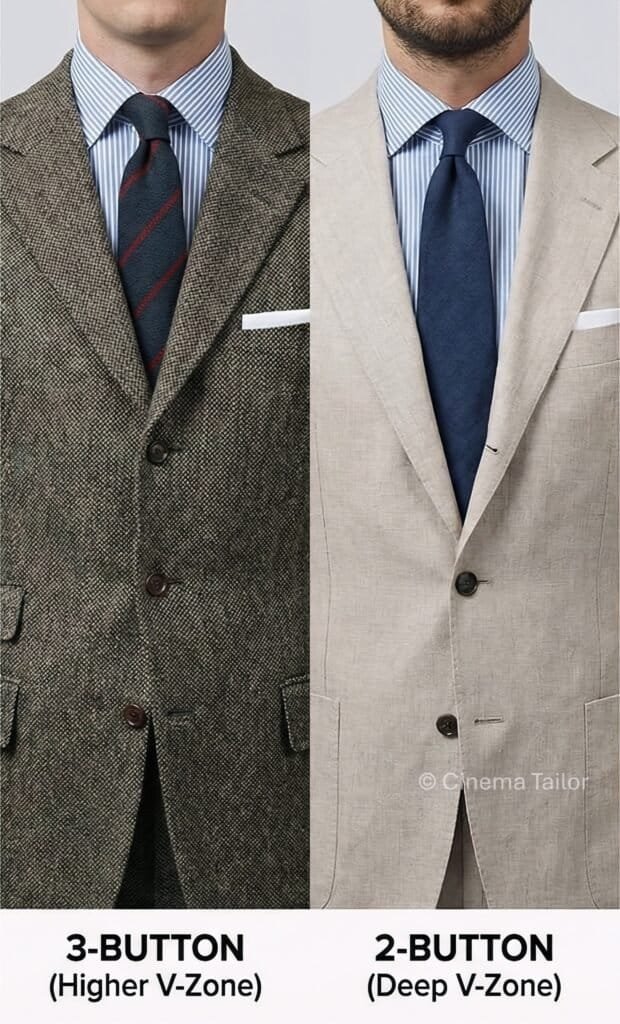
- The Deep V-Zone Effect A two-button jacket has a lower buttoning point compared to a three-button jacket. This creates a deeper “V-shape” on your chest.
- Visual Benefit: It elongates your torso, making you look taller and slimmer.
- Style Tip: Never button the bottom button. This disrupts the silhouette and ruins the drape of the fabric.
- The “Barchetta” Pocket A distinct feature of high-end Italian jackets is the Barchetta (little boat) breast pocket. Unlike the straight English pocket, it is curved like a boat. This subtle curve follows the shape of the chest, adding a touch of three-dimensional elegance.
| Feature (Component) | Technical Spec (Logic) | User Benefit (Output) |
| Two-Button Closure | Lower Button Stance | Elongates the torso; creates a deep V-zone |
| High Armholes | Precision Engineering | Maximizes range of motion without pulling |
| Soft Shoulders | Unstructured Architecture | Provides natural silhouette and comfort |
| Tapered Trousers | Slimmed Hemline | Clean lines with zero excess “noise” |
| Lightweight Canvas | Minimalist Internal Layer | High breathability for environmental adaptability |
The Trousers: The Magic of the “Tapered Fit”
The biggest difference between an average suit and a stylish Italian suit is often in the trousers. The Tapered Fit is non-negotiable in Italian sartorialism.
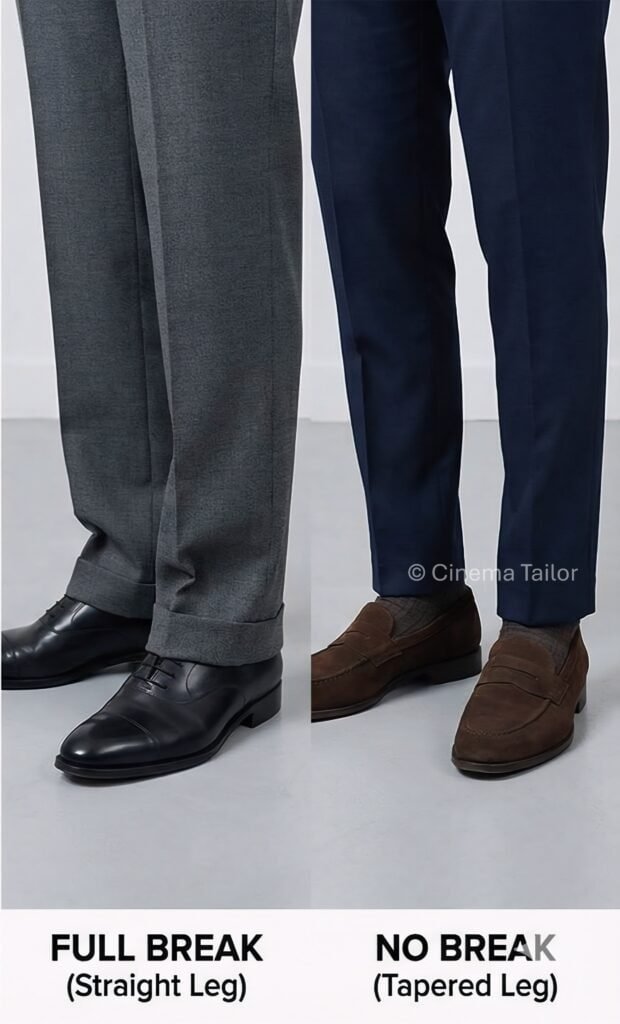
What is a Tapered Fit? Tapered trousers are roomier around the thighs (for comfort) but gradually narrow down towards the ankle. This is different from “Skinny fit” (which is tight everywhere) or “Straight fit” (which is loose everywhere).
Why Tapered?
- Clean Lines: It removes excess fabric flapping around your calves, creating a sharp, clean silhouette.
- Shoe Focus: A narrower leg opening (hem) draws attention to your shoes. Since Italians love their loafers and monk straps, the tapered cut is perfect for showing them off.
- No Break: Italian trousers typically have “No break” or a “Quarter break,” meaning the pant leg barely touches the shoe. This enhances the vertical line, again, making you look taller.
| Dimension | Standard Generic Fit | Italian Tapered Fit |
| Waistline | Loose / Straight-cut | High-waisted / Aggressively Suppressed |
| Thigh to Ankle | Uniform Width (Tube-like) | Gradual Narrowing (Anatomical) |
| Visual Weight | Heavy / Static | Agile / Dynamic |
| Breaking Point | Full Break (Frequent bundling) | No Break or Slight Break (Clean finish) |
| System Goal | One-size-fits-all | Personalized Optimization |
The Invisible Luxury: Unlined & Half-lined Construction
What truly defines an Italian suit isn’t just what you see on the outside, but what’s missing on the inside. Unlike the stiff, fully-lined armors of British tailoring, Italian masters often opt for ‘Unlined’ or ‘Half-lined’ (often called ‘Skeleton lining’) construction. By removing the heavy internal canvas and silk lining, the suit becomes light as a feather, allowing the fabric to breathe and follow the natural movements of your body. This is the secret behind that effortless ‘Sprezzatura’ look—a suit that feels as comfortable as a second skin.
How to Achieve the “Cinema Tailor” Look
If you want to replicate the styles seen in movies like The Great Beauty or House of Gucci, follow these three rules:
- Soft Shoulders: Look for jackets with minimal or no padding. Let your natural shoulder line show.
- Texture Matters: Italians love texture. Instead of flat worsted wool, opt for flannel, linen, or high-twist wool to add depth to your outfit.
- Accessorize with Confidence: A simple white pocket square or a knit tie can be the finishing touch that completes your Sprezzatura.
FAQ: Mastering the Italian Protocol
Q1. Is the Two-Button style less formal than the Three-Button?
A: Not necessarily. In the Italian protocol, the two-button is considered a versatile standard. It provides a cleaner, more modern interface that works perfectly from the boardroom to an evening social event.
Q2. Does a Tapered Fit work for all body types?
A: Yes, because it is based on proportional optimization. For a larger frame, the taper is adjusted to create a streamlined silhouette that reduces visual bulk. It’s about creating an illusion of height and agility.
Q3. Why do Italians prefer “Soft” shoulders over structured ones?
A: It represents the philosophy of “Freedom within Architecture.” A soft shoulder allows the wearer to move naturally, projecting a sense of relaxed authority rather than a rigid, defensive posture.
Checklist: Auditing Your Italian Silhouette
- [ ] The Button Pivot: Is the top button positioned exactly at your natural waistline for optimal balance?
- [ ] The Lapel Roll: Does the lapel roll softly towards the button, indicating a high-quality “soft” architecture?
- [ ] The Taper Logic: Do the trousers follow the natural curve of your leg without feeling restrictive?
- [ ] The Sleeve Pitch: Is there a subtle narrowing toward the cuff to complement the overall tapered aesthetic?
- [ ] The “Sprezzatura” Gap: Does the suit maintain its shape even when moving with effortless, unstudied grace?
Conclusion
At the end of the day, an Italian suit is just a high-performance interface. After 20 years of managing infrastructures, I know that the best hardware in the world is useless if the operator is rigid.
Choosing the Two-button jacket and Tapered trousers is about removing friction. It’s about ensuring your physical layer doesn’t lag behind your executive intent. But remember, the “Sexiness” people talk about isn’t in the fabric—it’s in the unwavering confidence that comes when you no longer have to worry about your gear.
Stop over-engineering your look. Optimize your silhouette, trust the architecture, and then forget you’re wearing it. Move with authority. That is the only protocol that matters.
For a cinematic case study of Italian tailoring shaping masculine authority, see
The Architect of Cinematic Elegance: How Valentino Garavani Tailored the Silver Screen.
The functional side of Italian tailoring is further explored in
Why John Wick Unbuttons His Sleeves (The Physics of Surgeon’s Cuffs).
James is a UI software expert with over 20 years of experience in the IT industry.
He is the editor of Cinema Tailor, where he analyzes cinematic style and visual storytelling through a structured, system-level perspective.